
 English
 Español
Content
- 1 Marine Chiller Unit Cooling Capacity Must Match Real Load, Not Nameplate Load
- 2 Marine Chiller Unit Energy Efficiency Drives Total Operating Cost at Sea
- 3 Marine Chiller Unit Corrosion Resistance Determines Real Service Life
- 4 Marine Chiller Unit Maintenance in Confined, Hard-to-Reach Spaces
- 5 Marine Chiller Unit for Offshore Applications Faces Additional Demands
- 6 Marine Chiller Unit vs Air Cooled Chiller: Which Fits Your Vessel
- 7 Frequently Asked Questions
A marine chiller unit operates in an environment that destroys ordinary industrial cooling equipment within a few seasons. Constant salt spray, vibration from engine rooms, humidity near saturation, and the total absence of convenient service access mean a chiller built for a factory floor will fail at sea. Selecting the right marine chiller unit means weighing cooling capacity, energy draw, corrosion resistance, and maintenance access against the realities of a vessel that may be hundreds of miles from the nearest qualified technician.
Marine Chiller Unit Cooling Capacity Must Match Real Load, Not Nameplate Load
Marine chiller unit cooling capacity is rated under standard test conditions that rarely reflect actual operating conditions aboard a vessel. Engine room ambient temperatures routinely exceed 40 degrees Celsius, and seawater-cooled condensers face inlet water temperatures that shift with latitude and season, both of which derate the chiller's effective output well below its catalog tonnage.
Correct sizing accounts for heat load from electronics racks, accommodation air conditioning, refrigerated cargo holds, or process cooling simultaneously, then adds a safety margin of roughly 15 to 20 percent. Undersized units cycle compressors harder and shorten compressor life, while oversized units short-cycle and waste energy at partial load.
Marine Chiller Unit Energy Efficiency Drives Total Operating Cost at Sea
Marine chiller unit energy efficiency matters more on a vessel than almost any shore-based application, since every kilowatt the chiller draws is a kilowatt the ship's generators must produce from fuel carried aboard. A chiller with a poor coefficient of performance does not just cost more to run, it reduces fuel range and increases generator maintenance frequency.
- Variable speed compressors adjust output to actual load instead of cycling on and off, cutting energy use significantly during partial-load periods common in port or at anchor.
- Electronic expansion valves maintain tighter superheat control than mechanical valves, improving evaporator efficiency across varying seawater temperatures.
- High-efficiency heat exchangers with optimized fin or plate design extract more cooling per unit of compressor work, particularly important on units constrained by engine room footprint.
Marine Chiller Unit Corrosion Resistance Determines Real Service Life
Marine chiller unit corrosion resistance is the single factor that most separates marine-rated equipment from relabeled industrial chillers. Salt-laden air attacks unprotected steel, aluminum fins, and even some stainless alloys within months, leading to refrigerant leaks at fitting points and structural failure of cabinet panels.
Specifications worth checking before purchase include titanium or cupronickel tube bundles for seawater-cooled condensers, since these resist chloride pitting far better than standard copper. Cabinet construction in 316L stainless steel outperforms painted mild steel or even 304 stainless in salt spray testing. Epoxy-coated aluminum fins on air-cooled condenser coils extend coil life substantially compared to bare aluminum, which pits and loses heat transfer efficiency within a year or two of coastal exposure.
Marine Chiller Unit Maintenance in Confined, Hard-to-Reach Spaces
Marine chiller unit maintenance routines differ from shore-based servicing because engine rooms rarely offer the clearance, lighting, or parts availability of a land-based mechanical room. Maintenance planning has to assume long intervals between dry dock periods and the possibility that a failed part cannot be sourced until the next port call.
Weekly Visual and Pressure Checks
Crew inspect refrigerant pressures, check for oil residue at fittings indicating leaks, and confirm condenser water flow rates remain within design range.
Monthly Coil and Strainer Cleaning
Seawater strainers and condenser tubes accumulate marine growth and sediment that reduce heat transfer, requiring scheduled backflushing or mechanical cleaning.
Quarterly Electrical and Control Verification
Humidity-prone control panels and contactors are checked for corrosion on terminals, and sensor calibration is verified against a reference thermometer.
Annual Refrigerant and Compressor Service
Full refrigerant charge verification, compressor oil analysis, and vibration isolation mount inspection are completed during scheduled yard or dry dock periods.
Marine Chiller Unit for Offshore Applications Faces Additional Demands
A marine chiller unit for offshore applications, such as oil platforms, offshore wind support vessels, or research stations, must tolerate continuous vibration, extended periods without shore power backup, and in many cases hazardous area electrical certification. These units typically run on redundant compressor configurations so a single compressor failure does not eliminate all cooling capacity, since offshore platforms cannot simply dock for emergency repair.
Offshore-rated units also commonly include enhanced anti-vibration mounting and reinforced piping connections, since platform and vessel motion subjects refrigerant lines to fatigue stress that stationary industrial chillers never experience.
Marine Chiller Unit vs Air Cooled Chiller: Which Fits Your Vessel
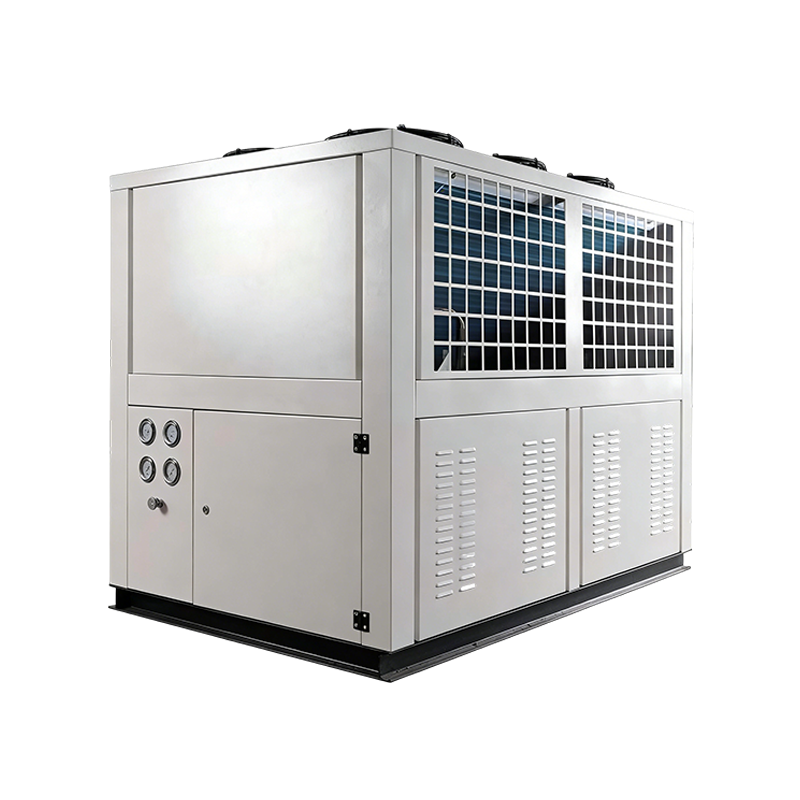
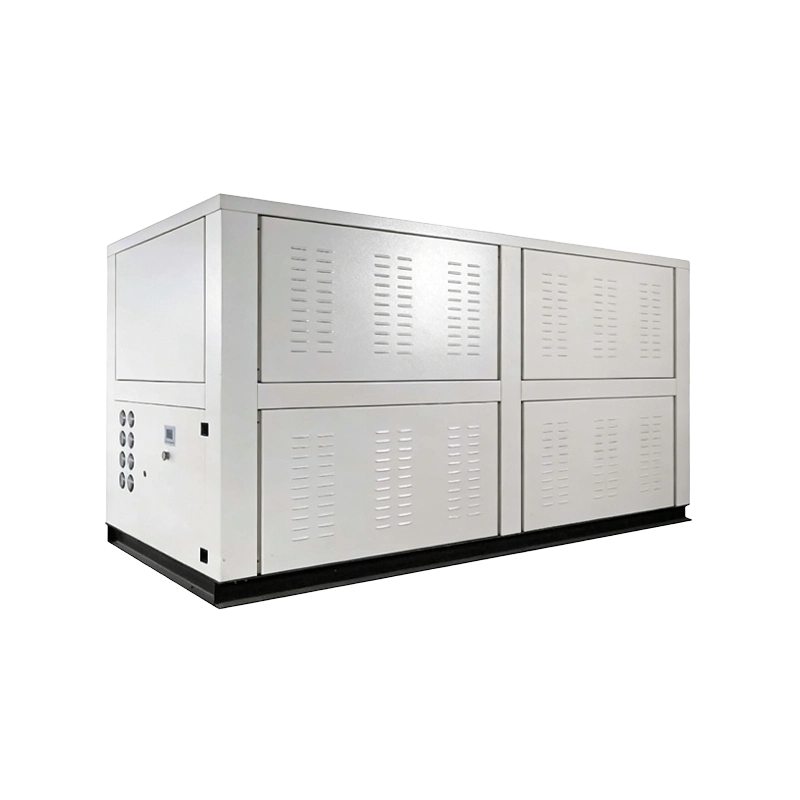
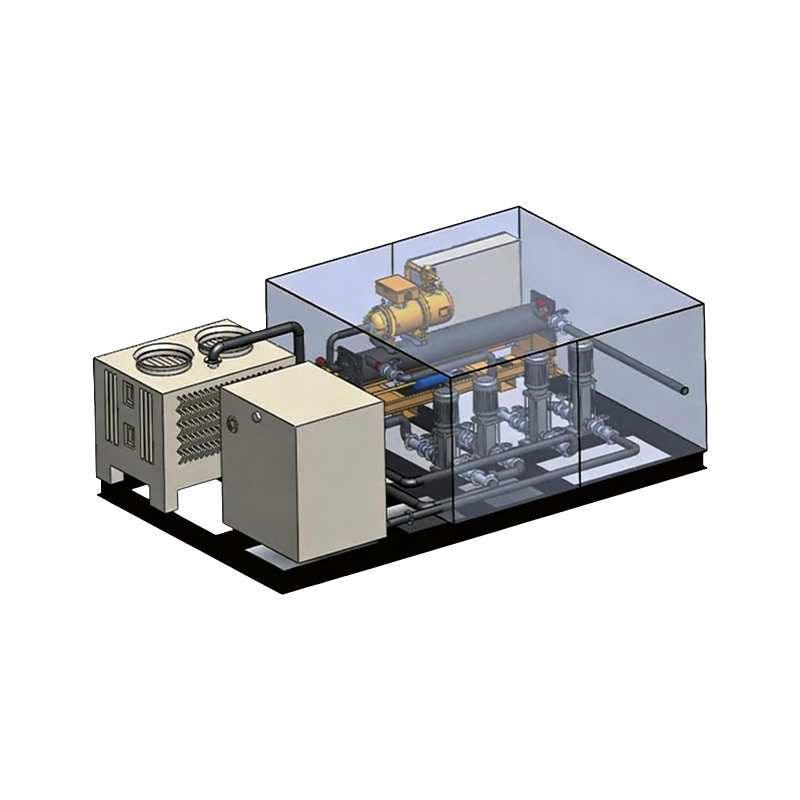
Seawater-Cooled Marine Chiller
Uses seawater as the condenser heat sink, delivering higher efficiency and more consistent performance regardless of engine room ambient temperature. Requires sea chest piping, strainers, and periodic tube cleaning, and depends on hull-mounted intake integrity.
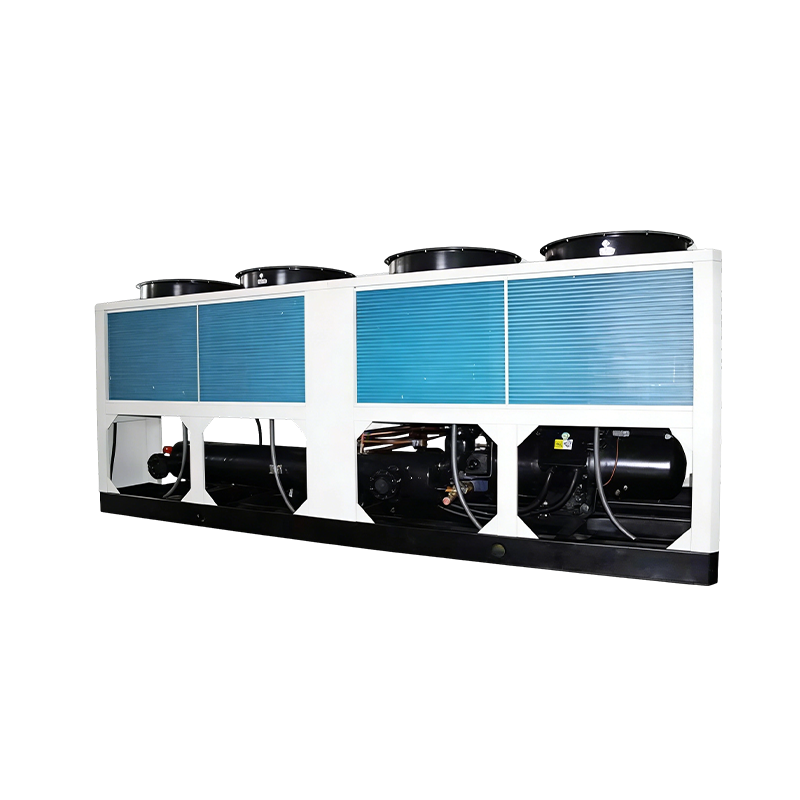
Air Cooled Marine Chiller
Rejects heat to ambient air, avoiding seawater piping complexity and the corrosion risk of seawater-wetted components. Performance drops in hot engine rooms or tropical climates, and coated coils are essential to survive salt-laden airflow.
| Factor | Seawater-Cooled | Air-Cooled |
| Efficiency in hot climates | Stable, less affected by ambient heat | Reduced at high ambient temperature |
| Installation complexity | Higher, requires sea chest and piping | Lower, simpler ducting only |
| Corrosion exposure | Internal tube fouling and pitting risk | Coil and cabinet salt air exposure |
| Best suited for | Larger vessels with engine room space | Smaller craft or weight-sensitive layouts |
Frequently Asked Questions
How is marine chiller unit cooling capacity sized correctly for a vessel
Capacity is sized from actual measured heat loads, including electronics, accommodation cooling, and process loads, with a safety margin of roughly 15 to 20 percent added to account for derating at high ambient or seawater temperatures.
What materials offer the best corrosion resistance in marine chillers
Titanium or cupronickel condenser tubes, 316L stainless steel cabinets, and epoxy-coated aluminum fins consistently outperform standard industrial-grade materials in salt air and seawater exposure.
How often should a marine chiller unit be serviced
Effective maintenance programs combine weekly pressure checks, monthly coil and strainer cleaning, quarterly electrical inspection, and annual refrigerant and compressor service during scheduled dry dock periods.
Is a seawater-cooled or air-cooled chiller better for offshore use
Seawater-cooled units generally deliver more stable efficiency in hot climates and heavier loads, while air-cooled units suit smaller vessels or installations where avoiding seawater piping outweighs the efficiency advantage.