English
 Español
Welcome to Soouney

Custom Water Cooled Screw Evaporative Cooling Chiller
Search Here
Services List
Feel Free to Contact Us
WhatsApp:+86 18921753771


About Soouney.
Read More
A Technological Benchmark In The Industrial Refrigeration Sector
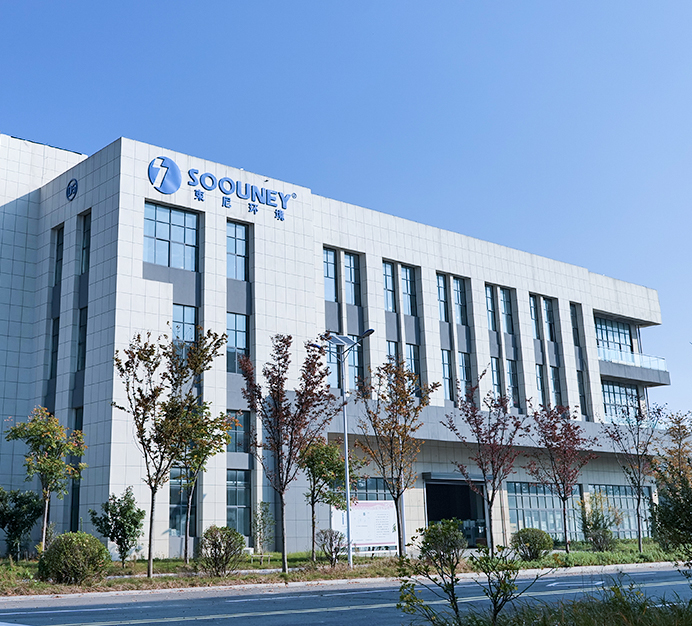
Shanghai Soouney Refrigeration Equipment Co., Ltd. is a large-to-medium-sized high-tech enterprise within Shanghai's refrigeration sector, integrating research, development, production and sales. We China Water Cooled Screw Evaporative Cooling Chiller Manufacturers and Custom Water Cooled Screw Evaporative Cooling Chiller Factory. Upholding the quality principles of 'integrity, quality, service and innovation', the company pursues a development philosophy centred on humanisation and technological advancement, driving product R&D and manufacturing with high starting points and stringent standards. It has now grown into a renowned brand in the domestic and international markets for cabinet air conditioners and industrial chillers, earning high recognition from industry professionals and a broad customer base. Rooted in the Chinese market, it provides reliable refrigeration solutions to clients worldwide. We focus on international trade and B2B business, providing tailored solutions to global clients. We ensure the smooth, stable, and long-term operation of your projects with a comprehensive research and development, production, sales, and after-sales service system. We have nearly 20 years of experience in providing one-stop solutions for overseas projects.
-
 0
0Site Area
-
 0
0Established
-
 0+
0+Employees
Pay Attention To Our Latest News And Exhibitions
View All News
What'S News?
-
Industry NewsLearn More
-
Industry NewsLearn More
-
Industry NewsLearn More
-
Industry NewsLearn More
-
Industry NewsLearn More
Water Cooled Screw Evaporative Cooling Chiller Industry knowledge
How Evaporative Condensing Works Inside a Screw Chiller
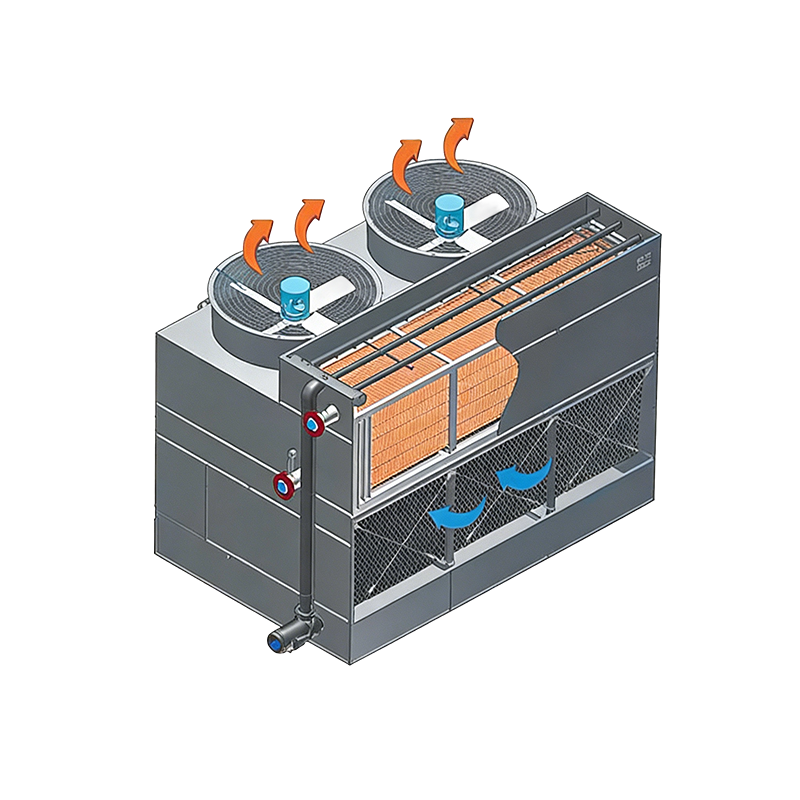
A water cooled screw evaporative cooling chiller replaces the conventional shell-and-tube condenser — and the separate cooling tower it depends on — with an integrated evaporative condenser. In this design, hot refrigerant gas leaving the compressor flows through a coil that is simultaneously wetted with spray water and exposed to a forced airstream. As a fraction of the spray water evaporates, it carries away latent heat directly from the refrigerant coil, condensing the refrigerant without requiring a separate heat exchanger loop.
The thermodynamic advantage is meaningful. Conventional cooling tower systems reject heat through two consecutive heat transfer steps — refrigerant to condenser water, then condenser water to atmosphere — each with its own approach temperature penalty. Evaporative condensing collapses this into a single step, allowing the refrigerant to condense at a temperature closely approaching the ambient wet-bulb rather than the dry-bulb. In moderate climates, this means condensing temperatures 8–12°C lower than an equivalent air cooled system operating in the same conditions, directly reducing compressor lift and energy consumption.
Shanghai Soouney Refrigeration Equipment Co., Ltd. integrates this evaporative condensing principle into screw chiller platforms designed for industrial and commercial applications where both efficiency and installation simplicity are priorities.
Wet-Bulb Dependence and Seasonal Performance Variation
Because evaporative heat rejection is driven by the latent heat of water evaporation, the effective condensing temperature tracks ambient wet-bulb temperature rather than dry-bulb. This has significant implications for how performance is specified, modelled, and compared across climates.
Wet-bulb temperature is always equal to or lower than dry-bulb temperature — the difference depends on relative humidity. In dry climates (Middle East, inland Australia, northern China summers), dry-bulb temperatures may reach 40°C while wet-bulb remains at 22–26°C, giving evaporative systems a very large operating advantage. In humid tropical climates (Southeast Asia, coastal West Africa), wet-bulb temperatures approach dry-bulb, narrowing the evaporative benefit.
For accurate lifecycle cost analysis, performance should be modelled against the full annual wet-bulb frequency distribution for the project site — not just peak design conditions. Key reference points:
- Design wet-bulb (0.4% annual exceedance): used for peak capacity sizing
- Mean wet-bulb during occupied or process hours: drives average annual COP
- Winter wet-bulb minimums: relevant for capacity control and freeze protection strategy
A water cooled screw evaporative cooling chiller installed in a semi-arid climate will typically achieve annual average COPs 20–35% higher than an air cooled screw chiller of equivalent capacity, with the gap widening further during summer peak loads when the efficiency advantage matters most.
Water Consumption, Drift, and Legionella Risk Management
Evaporative cooling systems consume water through three pathways: evaporation (the working mechanism), blowdown (deliberate purging to control mineral concentration), and drift (fine water droplets carried out with exhaust air). Managing all three is essential for both operating cost and public health compliance.
Evaporation accounts for approximately 1–2 litres per hour per kilowatt of heat rejected under design conditions — unavoidable, as it is the basis of the technology. Blowdown is controlled by the cycles of concentration (CoC) setting: higher CoC reduces blowdown volume but increases scaling risk. Most systems operate at CoC 3–5, balancing water savings against water treatment requirements.
Drift is the primary Legionella transmission pathway. Modern evaporative condensers use high-efficiency drift eliminators that reduce drift loss to 0.001–0.003% of circulated water flow, but they do not eliminate the risk entirely. Regulatory frameworks in the EU (ASHRAE 188, EN 13779), Australia (AS/NZS 3666), and many other jurisdictions mandate written water management plans for evaporative cooling equipment, including routine microbiological testing, disinfection protocols, and system inspection schedules.
Buyers should confirm local regulatory requirements before equipment procurement and factor water treatment operating costs — chemical dosing, conductivity monitoring, periodic biocide treatment — into total cost of ownership calculations. Soouney provides documentation support for projects requiring compliance with international water safety standards.
Dry Operation Mode and Winterisation Strategies
One underappreciated feature of evaporative screw chillers is the ability to operate in dry mode — with spray water pumps off and fans running only — during cold weather. When ambient temperatures drop sufficiently, sensible heat transfer alone is adequate to condense the refrigerant without evaporative augmentation. This eliminates water consumption and associated treatment costs during cooler months and reduces freeze risk in cold climates.
Transition logic between wet and dry operating modes is managed by the chiller controller based on ambient wet-bulb temperature, condensing pressure setpoint, and compressor load. Well-implemented controls switch seamlessly between modes without operator intervention, optimising water consumption across the full annual operating cycle.
For installations in climates with sub-zero winters, additional winterisation measures apply:
- Basin heaters to prevent sump water from freezing during standby periods
- Gravity drain or automatic drain-down of spray water circuits when ambient falls below a set threshold
- Trace heating on exposed pipework and water distribution headers
- Anti-freeze additives in sump water where drain-down is impractical
Our water cooled screw evaporative cooling chiller configurations include factory-fitted winterisation packages for projects in northern China, Central Asia, and other cold-climate markets. With nearly 20 years of overseas project experience, Soouney's engineering team can specify the appropriate cold-weather protection level based on site-specific minimum ambient data.
Quick Links
Product Categories
Contact Us
-
 Email: [email protected]
-
 Whatsapp: +86 18921753771
-
 Mobile Phone : +86-18921753771
Mobile Phone :+86-13022163998 -
 Telephone: +86-021-58223918
-
 No. 128 Hui'an Road, Fengxian District, Shanghai, China