
 English
 Español
Content
- 1 Start With a Heat-Load Balance, Not a Tonnage Guess
- 2 Choose the Heat Rejection Method Before the Model
- 3 Part-Load Efficiency Decides the Electricity Bill
- 4 Refrigerant, Setpoint and Fluid Compatibility
- 5 Electrical Supply, Footprint and Service Access
- 6 Ten-Year Cost: Energy, Water and Maintenance
- 7 A Selection Checklist for the Quotation Stage
- 8 Decisions That Still Trip Buyers Up
A plating line that keeps rejecting parts usually traces back to one afternoon. The chilled-water header drifted 1.5 K above setpoint during the second shift, the rectifier tripped on over-temperature, and the line stopped for four hours. The chiller was not faulty. It had been bought on tonnage alone, with no heat-load balance, no design ambient and no part-load data behind the decision.
Start With a Heat-Load Balance, Not a Tonnage Guess
Sizing an industrial chiller begins with a heat-load balance expressed in kW or BTU/hr, because tonnage is only a unit conversion: 1 refrigeration ton equals 12,000 BTU/hr, or 3.517 kW. A machine ordered from a converted nameplate rating rather than from measured process heat will be wrong in both directions at once, oversized for the average day and undersized for the worst one.
Build the balance from every source that puts heat into the loop, not only from the obvious one:
- Drive and motor losses that end up in the process fluid rather than in the finished part
- Resistance or exothermic heat from rectifiers, induction coils, lasers and welding equipment
- Product load, calculated as mass flow multiplied by specific heat multiplied by the required temperature drop
- Pump energy, which is fully absorbed by the loop, so a 15 kW circulation pump adds 15 kW of heat
- Ambient gain through tank walls, uninsulated headers, flexible hoses and open process baths
A margin of 10% to 15% covers condenser fouling, a future tool upgrade and the gap between calculated and measured gain. Push past 20% and the margin starts working against the plant. The compressor cycles more often, the evaporator loses stability at low load, and the leaving-water temperature swings wider than it did with no margin at all.
Write the heat load on the quotation request as a single number in kW, followed by the ambient dry-bulb and wet-bulb design points. Chiller capacity is never a fixed quantity; it falls as ambient rises, and a supplier without the design ambient cannot guarantee anything.
Choose the Heat Rejection Method Before the Model
At AHRI 550/590 rating conditions, a water-cooled screw chiller published at 0.55-0.70 kW/ton draws roughly 35% to 50% less full-load power than an air-cooled machine published at 1.05-1.25 kW/ton. Those figures only mean something alongside the rating condition behind them: 6.7 C leaving chilled water, 29.4 C entering condenser water for water-cooled units, and 35 C ambient air for air-cooled units.
Air-cooled
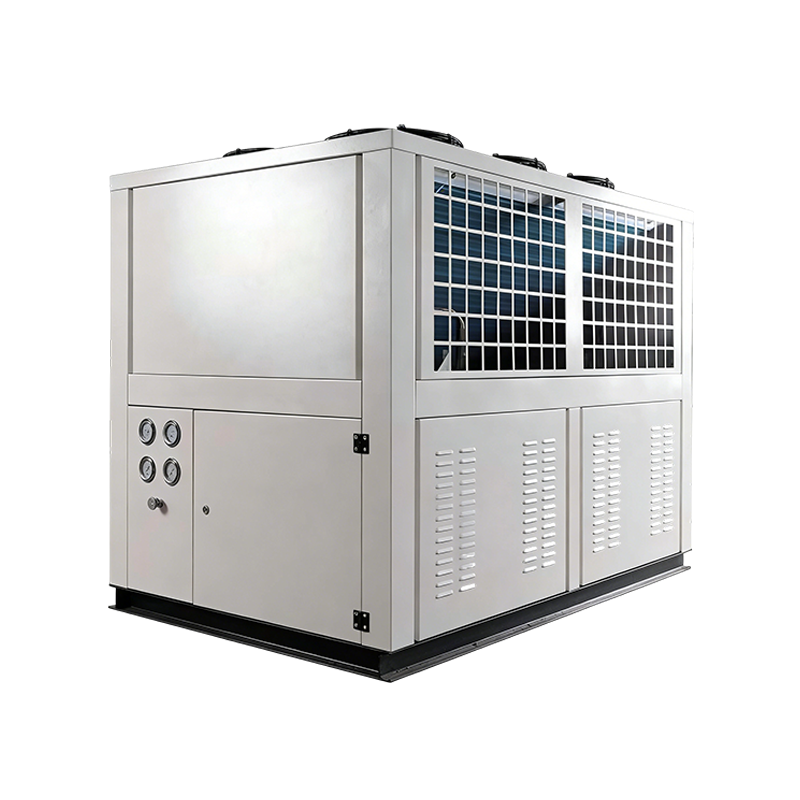
No cooling tower, no condenser pumps, no water treatment contract and no winter freeze protection on an outdoor water circuit. The trade-off is roughly double the compressor power per ton of cooling and a capacity that drops as ambient climbs, typically around 8% to 12% between 35 C and 43 C.
Water-cooled
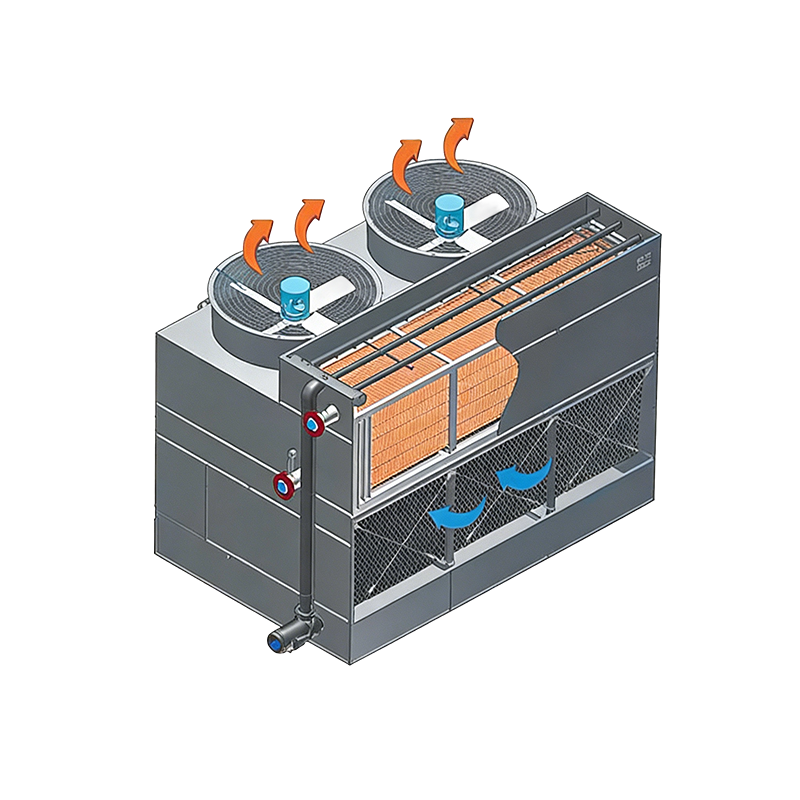
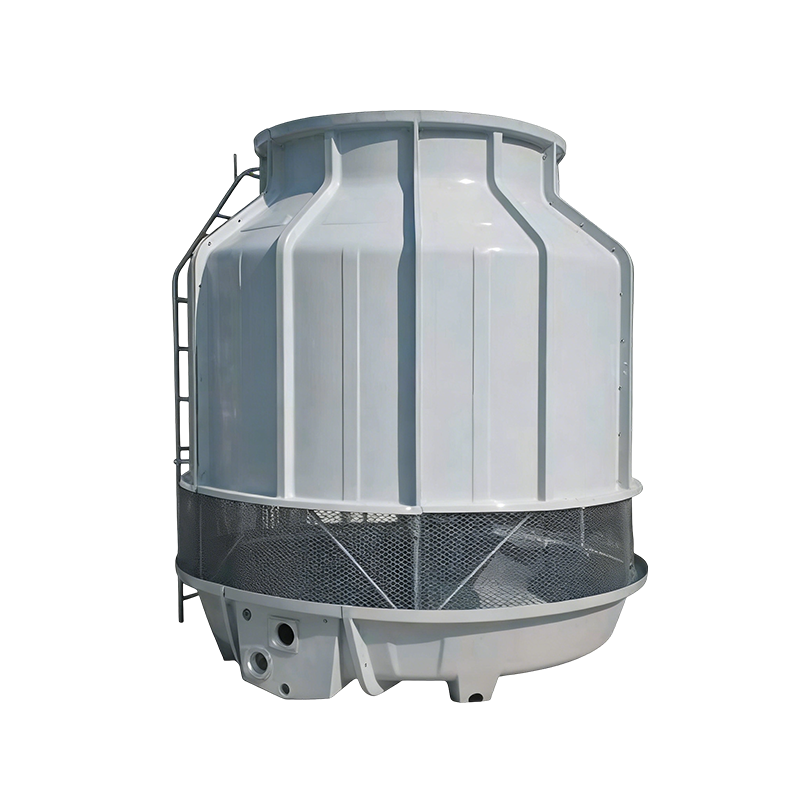
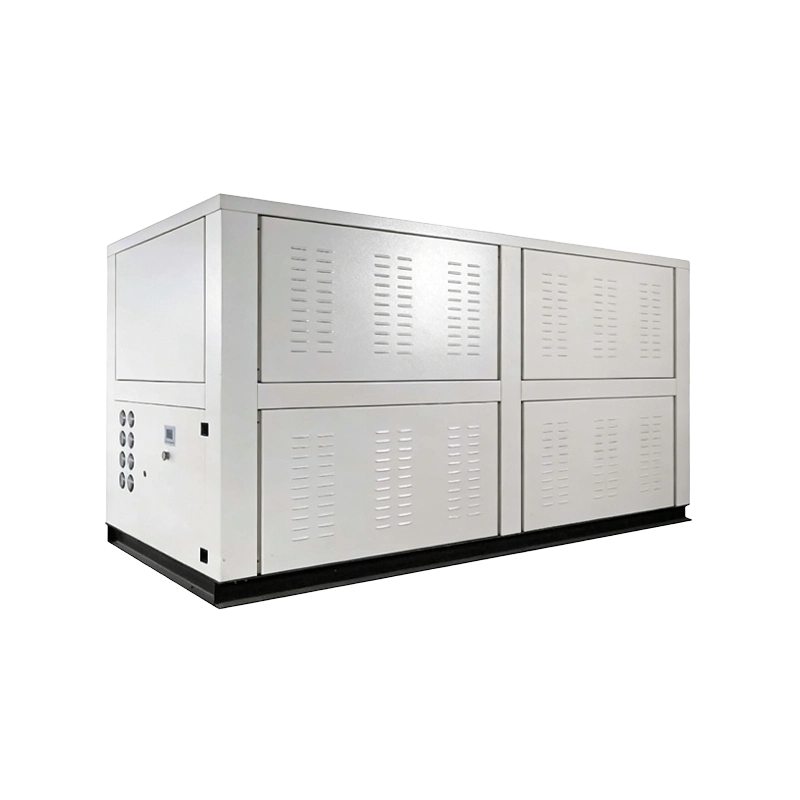
The lowest compressor power per ton and the longest service life, provided the tower is sized correctly and the condenser tubes are cleaned on schedule. It needs a tower, condenser pumps, makeup water and a treatment programme, so it suits plants that run 4,000 hours a year or more.
Where the process loop must stay clean and the condenser circuit is open to atmosphere, an isolating heat exchanger between the two circuits is worth pricing at the same time, since it protects the evaporator from scale and biological fouling carried in from the tower. A maintenance-free water heat exchanger is one option for that boundary.
| Method | Typical full-load range | Condenser water needed | Where it fits |
| Air-cooled | 1.05-1.25 kW/ton | No | Plants without a tower, short run hours, outdoor installation |
| Water-cooled | 0.55-0.70 kW/ton | Yes, at 29.4 C design | Two-shift and three-shift continuous process loads |
| Evaporative condenser | 0.50-0.60 kW/ton | Yes, plus makeup water | Hot, dry climates with high annual run hours |
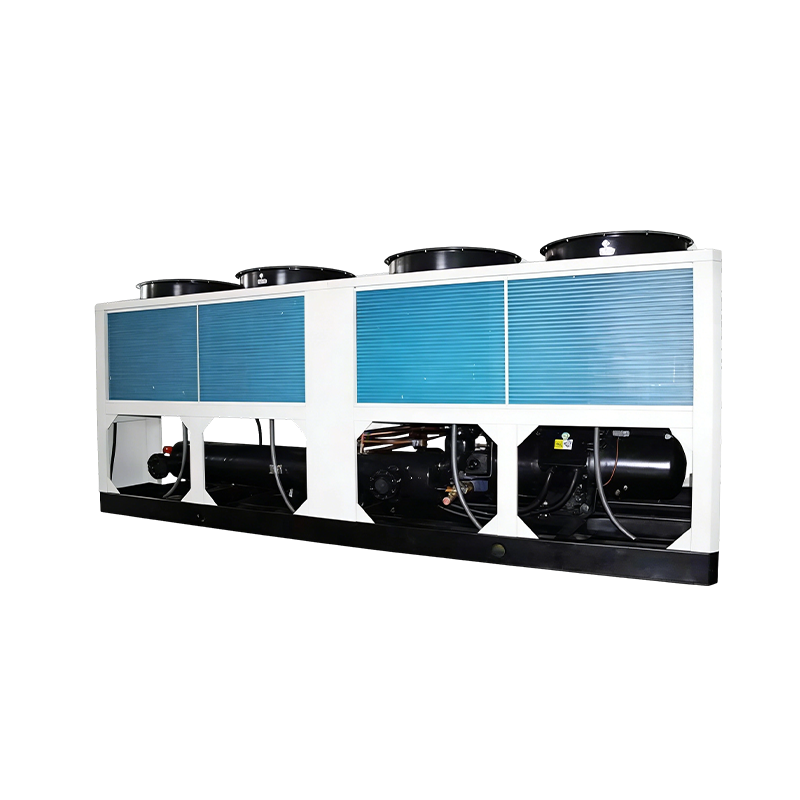
An air-cooled machine remains the correct answer for a plant without a tower, a plant running 2,000 hours a year, or a plant where water treatment cannot be managed reliably. Air-cooled packages in the 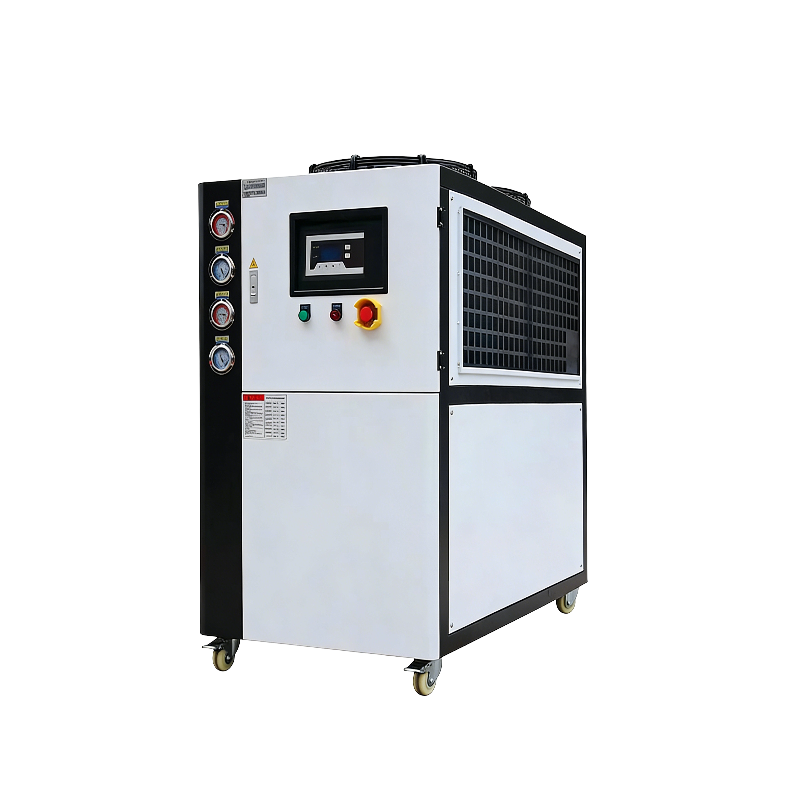 Air Cooled Industrial Chiller ManufacturersShanghai Soouney Refrigeration Equipment Co., Ltd. is a large-to-medium-sized high-tech enterprise within Shanghai's refrigeration sector, integrating research, develo...View Product → range cover these cases without a condenser water circuit.
Part-Load Efficiency Decides the Electricity Bill
A process chiller in a two-shift plant runs below 50% capacity for most of its life, so integrated part-load value predicts the electricity bill far better than the full-load kW/ton printed on the first page of a datasheet. AHRI 550/590 weights the part-load points as 1% at 100% load, 42% at 75%, 45% at 50% and 12% at 25%, which means 87% of the weighting sits at 75% load or lower.
That weighting explains why compressor technology matters more than nominal capacity. Three points decide the outcome:
- Screw compressors with a slide valve or variable-speed drive hold efficiency down to roughly 25% load, while fixed-speed scroll banks lose ground once stages begin to cycle
- A flooded evaporator raises suction pressure slightly and improves efficiency at every load point compared with a direct-expansion evaporator of the same nominal capacity
- Condenser approach temperature, not compressor size, often explains why a unit rated at 0.60 kW/ton delivers 0.72 kW/ton in service
A chiller specified on full-load kW/ton alone can lose 15% to 20% of its expected efficiency once the plant runs at 40% load. Request the part-load curve at the site ambient and confirm where the machine actually spends its hours before signing.
For loads that stay above 300 kW for most of the year, a flooded water-cooled screw machine is usually the efficiency benchmark for the category. Equipment such as the 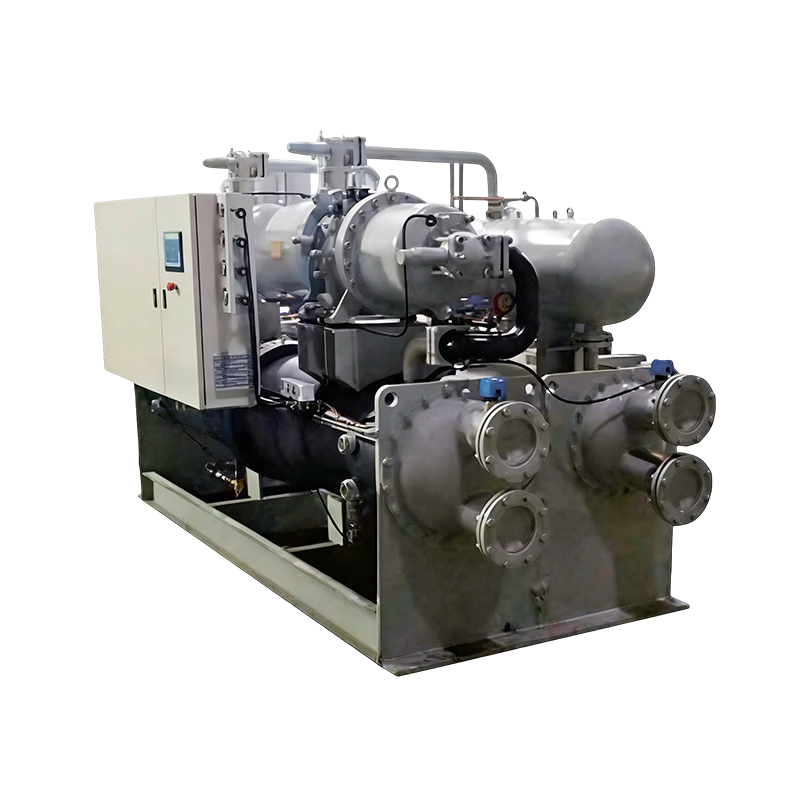 Water Cooled Screw Flooded ChillerElectronic expansion valve Electronic expansion valve has proportional integral regulator technology, to allow better control of air conditioner units and reduce runni...View Product → line is built around that duty profile.
Refrigerant, Setpoint and Fluid Compatibility
Refrigerant choice affects safety classification, service availability and future cost more than it affects capacity, and it should be confirmed against ASHRAE Standard 34 before the order is placed. R-134a and R-513A sit in safety group A1, while R-32 and R-454B sit in group A2L, which brings additional charge limits and ventilation requirements for indoor machine rooms.
On the secondary side, glycol concentration drives both freeze protection and pump power. A 30% ethylene glycol solution protects a loop down to about -15 C but adds 10% to 20% to pump power compared with plain water, because the mixture is denser and more viscous. Over-concentrating the glycol to be safe costs money every hour the plant runs.
State the setpoint with a tolerance, for example 7 C with plus or minus 0.5 K, and never specify colder than the process needs. Every 1 K of unnecessary sub-cooling on the evaporator adds roughly 2% to 3% to compressor power, so a setpoint set 3 K lower than required can add close to 10% to the annual electricity bill.
Electrical Supply, Footprint and Service Access
Confirm the actual supply characteristics, whether 380-415 V three-phase 50 Hz, 440-460 V three-phase 60 Hz, or 220 V single-phase for small package units, before the order is placed, because a different voltage or frequency is not a field retrofit. A machine built for 50 Hz will not deliver its rated capacity on a 60 Hz supply at the same speed, and rewinding or replacing a compressor after delivery costs more than the original price difference.
Three electrical numbers belong in every quotation: minimum circuit ampacity, maximum overcurrent protection, and locked-rotor amps. Starting method then determines the upstream protection. Direct-on-line starting draws roughly six to eight times full-load current, star-delta reduces the surge to about 2.5 times, a soft starter lands near three to four times, and a variable-speed drive holds starting current to about 1.5 to 2 times. In plants with a weak transformer or a generator-backed supply, that difference decides whether the chiller can start at all.
Certification should match the destination market: UL 1995 for North America, IEC 60335-2-40 for most other regions. Physically, leave at least 1 m of unobstructed air path on the condenser side of an air-cooled unit; recirculation of hot discharge air can cut usable capacity by more than 10% on a still day. Confirm the rigging route as well, since a 20-ton water-cooled screw package will not fit through a standard personnel door no matter how the site is arranged.
Ten-Year Cost: Energy, Water and Maintenance
Energy dominates the ten-year cost of a process chiller. At a load of 100 kW, which is 28.4 tons, and 4,000 operating hours a year, a unit running 0.20 kW/ton worse than an alternative draws about 22,700 kWh more annually. At USD 0.10 per kWh that is roughly USD 2,270 per year, or about USD 22,700 over a decade, before a single maintenance invoice is counted.
Water and chemistry costs follow the heat rejection method. An evaporative or tower-cooled system consumes makeup water and treatment chemicals and needs periodic blowdown, but it also reduces compressor power by roughly 10% to 15% against a water-cooled machine with a dry condenser, which is why the method suits plants with high annual run hours. Air-cooled units avoid water entirely and shift the maintenance burden onto coil cleaning, which should be scheduled at least twice a year in dusty plants.
Serviceability usually decides the last part of the comparison. Check the oil analysis interval, whether condenser tubes can be brushed without breaking refrigerant connections, and whether the controller exposes the fault history that a maintenance team actually needs. Options such as the 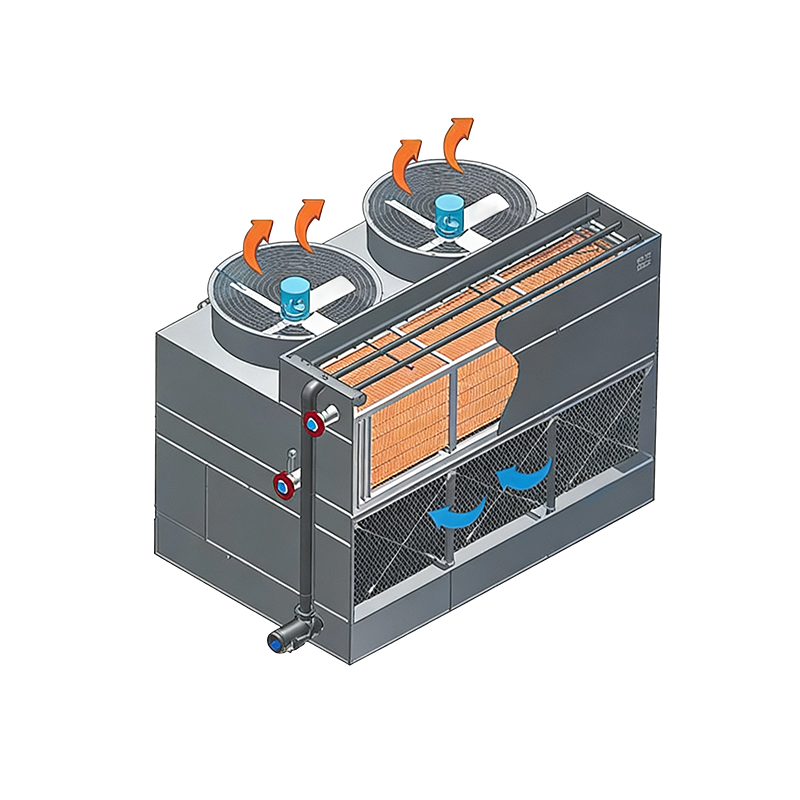 Low Operating Costs Significant Energy Savings Water Cooled Screw Evaporative Cooling ChilProduct Features · Premium heat exchange coils are optimally integrated with the heat exchange layer, complemented by a wide air intake surface. This achieves the opti...View Product → series are aimed at plants where the run hours make operating cost the deciding factor.
A Selection Checklist for the Quotation Stage
Buyers who work through seven steps in order avoid most of the selection errors that surface after commissioning. Each step produces a document, not a conversation.
- Fix the heat load in kW and write the design ambient dry-bulb and wet-bulb next to it, so capacity can be verified at the real condition.
- State the required leaving-water temperature with a tolerance, and justify any value below 7 C against a process requirement.
- Confirm which heat rejection method is available year-round, including whether condenser water and a tower are actually present.
- Request performance data at the site conditions rather than at nominal rating conditions, plus the full part-load curve.
- Ask for MCA, MOP and starting current, and match them against the existing panel and transformer capacity.
- Compare IPLV across all offers, after converting every figure to kW/ton at the same AHRI 550/590 condition.
- Agree the service scope in writing: commissioning support, spare parts availability and response time for a stopped production line.
For plants cooling several different duties at once, for example a moulding cell alongside a laser cutter and a hydraulic power unit, it helps to compare how chiller types behave across those mixed profiles before narrowing the list. This selection guide for different industrial cooling duties walks through that comparison in more detail.
Decisions That Still Trip Buyers Up
What size chiller do I need for a 500 kW process load?
Divide 500 kW by 3.517 to get 142 tons, then add a 10% to 15% margin for fouling and future load, which lands near 160 tons. Two 80-ton units are usually a better purchase than one 160-ton machine: they provide N+1 redundancy, hold part-load efficiency higher, and allow one unit to be serviced while production continues.
Is a water-cooled chiller always the more efficient choice?
No. At AHRI 550/590 conditions a water-cooled screw chiller at 0.55-0.70 kW/ton beats an air-cooled unit at 1.05-1.25 kW/ton, but that comparison assumes a tower, condenser pumps and water treatment are already available. Below roughly 2,000 operating hours per year, an air-cooled chiller usually wins on total installed cost.
What leaving-water temperature should I specify?
Specify the process requirement plus a tolerance, for example 7 C with plus or minus 0.5 K, and never lower than the process genuinely needs. Every 1 K reduction in evaporating temperature adds roughly 2% to 3% to compressor power, so a setpoint 3 K colder than necessary can add close to 10% to the annual electricity bill.
How do I compare quotations that use different efficiency units?
Convert every offer to kW/ton at the same AHRI 550/590 condition, remembering that kW/ton equals 12 divided by EER, so an EER of 10 is 1.20 kW/ton. Then check the minimum efficiency tier that applies in the destination market, such as GB 19577 in China or ASHRAE 90.1 in the United States. A quotation that publishes only a 50% load EER is not comparable until it is converted.