
 English
 Español
Content
- 1 How an Air Cooled Industrial Chiller Removes Heat
- 2 Ambient Temperature Is the Dominant Factor
- 3 Condenser Coil Design and Fin Geometry
- 4 Fan Type, Airflow Path, and Installation Clearance
- 5 Refrigerant Charge and Circuit Function
- 6 Compressor Type and Part-Load Performance
- 7 Maintenance Practices That Protect Dissipation
- 8 Selection Checklist for Any New Air Cooled Industrial Chiller
- 9 Frequently Asked Questions
An air cooled industrial chiller rejects process heat by passing ambient air over finned condenser coils, which means its real-world cooling capacity is never a fixed number: it drifts with ambient temperature, coil condition, airflow path, and refrigerant charge. If you specify or operate these machines, the difference between nameplate tons and delivered tons can be 20 percent or more once site conditions and maintenance history are factored in.
How an Air Cooled Industrial Chiller Removes Heat
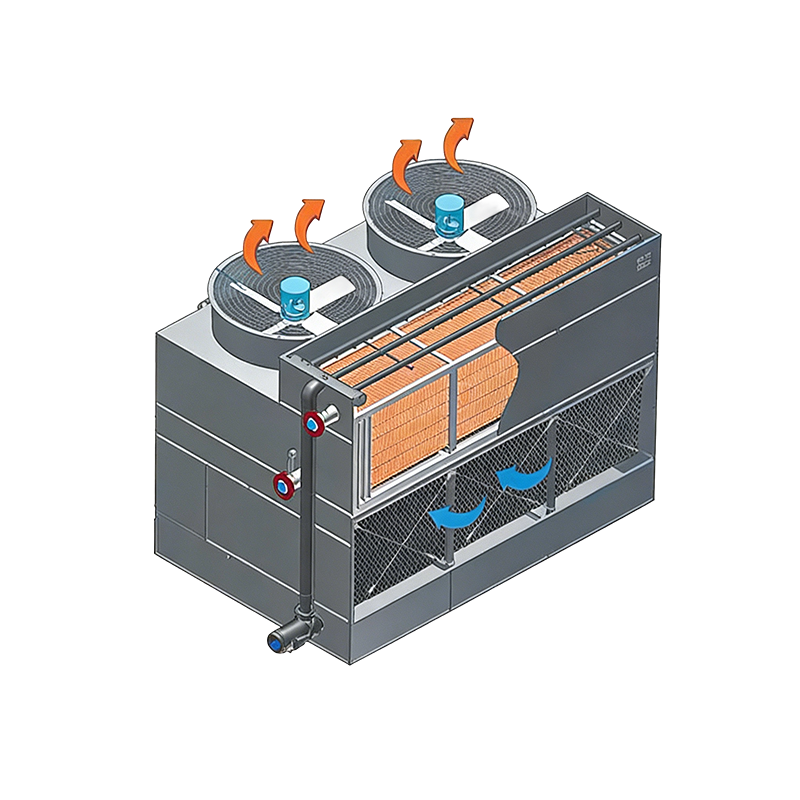
An air cooled industrial chiller moves heat from the process coolant to refrigerant inside the evaporator, then to the condenser coils, where axial fans push ambient air across the finned surface. The air stream absorbs sensible and latent heat, and the hot discharge air leaves the unit from the top or side of the machine. Because no cooling tower or water loop is involved, the entire heat rejection chain depends on the temperature difference between the condensed refrigerant and the surrounding air.
The key concept to remember is condensing temperature lift: the smaller the gap between condensing temperature and ambient dry-bulb temperature, the more efficiently the compressor runs. Every time that gap grows, power consumption climbs and delivered capacity falls.
Main Components That Influence Dissipation
- Condenser coil face area and fin density
- Fan airflow volume measured in cubic meters per hour
- Ambient dry-bulb and, to a lesser extent, wet-bulb temperature
- Compressor type and its part-load behavior
Ambient Temperature Is the Dominant Factor
Ambient temperature is the single strongest external variable for an air cooled industrial chiller. As outdoor dry-bulb temperature rises, the refrigerant must condense at a higher pressure and temperature to reject heat, which increases compression work and reduces net cooling output. A machine rated at 100 kW at 35°C ambient can often deliver only 90 kW or less at 40°C, depending on the compressor and coil sizing.
This behavior is why the industry quotes chiller capacity at standard ambient conditions rather than at one universal point. When comparing units, always check the stated ambient design condition and ask for performance data at your local peak summer temperature.
When Ambient Conditions Vary Across Seasons
Air cooled units perform best in moderate climates where summer peaks stay close to the design condition. In hot regions, the chiller may run for extended periods at high condensing pressure, which stresses the compressor and shortens service life. Some operators add evaporative pre-cooling pads or increasing fan speed to recover lost capacity during heat waves.
Condenser Coil Design and Fin Geometry
Condenser coil design determines how much heat can be rejected per square meter of face area. A larger coil with efficient fin geometry lowers the condensing temperature for the same heat load, which improves both capacity and efficiency. Standard coils use aluminum fins on copper tubes, while corrosive environments may require epoxy-coated fins or all-aluminum microchannel construction.
Fin density is a direct trade-off. Higher fins per inch increase surface area and heat transfer on clean, dry air, but they also trap dust and lint faster. Industrial settings with textile fibers, wood dust, or atmospheric pollution demand a wider fin spacing or regular cleaning intervals.
| Design Variable | Typical Range | Effect on Dissipation |
| Fin spacing | 8 to 14 fins per inch | Tighter fins improve transfer but clog faster |
| Tube row count | 2 to 5 rows | More rows increase surface area but raise air pressure drop |
| Face velocity | 1.5 to 3.5 m/s | Higher velocity boosts transfer until fan power becomes excessive |
Proper coil selection is not about maximum surface area alone. It is about matching the fin geometry, face velocity, and fan power to the expected ambient range and site air quality.
Fan Type, Airflow Path, and Installation Clearance
Fan performance controls how much air actually reaches the condenser coil. Axial fans are the standard choice for air cooled industrial chillers because they deliver high volumetric flow at low static pressure. Fan diameter, blade pitch, and motor power all set the maximum airflow, and any obstruction on the inlet or discharge side suppresses heat rejection.
The installation location matters just as much as the fan itself. A chiller placed too close to a wall recycles its own hot discharge air into the condenser inlet, which artificially raises the ambient temperature seen by the coil. This recirculation effect can cause a 5 to 10 percent capacity loss and may trigger high-pressure alarms on hot days.
Good installation
- Discharge air directed away from the inlet
- Minimum one meter clearance on all intake sides
- No roof overhang or partial enclosure above the fans
- Prevailing wind does not push hot air back into the unit
Bad installation
- Chiller tucked into a corner with small clearance
- Discharge air facing a high wall or adjacent equipment
- Multiple units arranged so hot exhaust feeds the next inlet
- Poor access for cleaning or service
Refrigerant Charge and Circuit Function
Heat dissipation is only as good as the refrigerant circuit that carries heat to the condenser. Low refrigerant charge reduces the mass flow through the system, so less heat arrives at the condenser coils even though the fans keep running. Overcharge is equally harmful because it floods the condenser surface, raising condensing pressure and reducing the effective heat transfer area.
Non-condensable gases in the circuit collect in the condenser and occupy volume that should hold refrigerant vapor. Even a small amount of air contamination increases discharge pressure and reduces chiller capacity. This is why routine maintenance must include checking subcooling, superheat, and approach temperatures rather than just verifying compressor operation.
Compressor Type and Part-Load Performance
Scroll and screw compressors dominate air cooled industrial chillers because they handle high condensing pressures better than reciprocating types. The compressor's displacement and the chiller's control logic decide how well heat rejection matches the load at partial output. Modern units use multiple compressors or variable-speed drives to avoid frequent cycling and to maintain low condensing pressure during cooler weather.
The project design point must align with the compressor family. For example, a fixed-speed scroll compressor running at low outside temperature will short-cycle if the control strategy cannot modulate capacity. An air cooled screw chiller with slide valve or variable-speed control holds a steadier condensing temperature, which protects the whole system.
Maintenance Practices That Protect Dissipation
No chiller design can remain at rated heat dissipation without a disciplined maintenance schedule. The condenser works against a continuous buildup of dust, insect debris, and atmospheric film that acts as an insulating barrier between the coil and the air. In moderately polluted industrial zones, a finned coil can lose 20 to 30 percent of its heat transfer capacity before the pressure rise triggers a service call.
- Inspect and clean condenser coils at least twice per year in dusty environments
- Check fan motors, bearings, and belt tension every month
- Monitor head pressure and approach temperature weekly
- Replace air filters on any enclosed louver or intake panel
Selection Checklist for Any New Air Cooled Industrial Chiller
Purchasing decisions should be made from part-load and full-load performance at the site's worst-case ambient condition, not from an average summer day. Ask the supplier for capacity curves that cover 30°C to 45°C ambient, or even 50°C if your facility runs processes in a hot climate zone.
- Confirm the required cooling capacity at the peak ambient temperature for the site
- Verify the condenser coil face area and fin spacing for that specific model
- Check fan airflow and whether the fans are fixed speed, two-speed, or variable speed
- Review dimensional drawings for minimum clearance against walls, pipes, and other units
- Ask about winter operation and any low-ambient control kit for year-round production
For industrial process cooling that requires stable output across summer peak conditions, demand data from an actual factory test, not only a theoretical selection program. The best combination for reliable heat dissipation pairs a generously sized coil, a robust fan set, and a control system that keeps condensing pressure low whenever the ambient allows.
Frequently Asked Questions
What is the largest factor affecting heat dissipation in an air cooled chiller?
Ambient dry-bulb temperature is the dominant factor because it sets the minimum condensing temperature the refrigerant can reach. Higher ambient temperature directly raises condensing pressure and reduces the cooling capacity a chiller can deliver.
Why does an air cooled chiller lose capacity in summer?
Summer temperatures increase the temperature lift between the condenser and the surrounding air. The compressor has to work harder, and the system must operate at higher pressure, which lowers net cooling output even if the fans run normally.
How often should condenser coils be cleaned?
A reasonable baseline is at least twice per year, but industrial sites with heavy dust or fibers may need monthly or even weekly cleaning. Monitoring the approach temperature between refrigerant condensing temperature and ambient air tells you when the coil has become restricted.
Can a fouled condenser cause compressor failure?
Yes. Restricted airflow or a dirty coil increases discharge pressure, which raises the compression ratio and oil temperature. Over time this can cause high-pressure trips, overheating, and compressor valve or bearing damage.