
 English
 Español
Content
- 1 Energy Efficiency Is Now a Compliance Requirement, Not a Marketing Feature
- 2 Low-GWP Refrigerants Move from Pilot Projects to Production Specifications
- 3 Smart Controls and Predictive Diagnostics Become Standard Equipment
- 4 Heat Recovery Turns Condenser Rejection into a Revenue Stream
- 5 Modular and Compact Chiller Designs Speed Up Deployment
- 6 Frequently Asked Questions
By 2026, the industrial chiller market is being reshaped by forces that no procurement budget can ignore: the refrigerant phase-down schedule of the Kigali Amendment is now binding in major markets, carbon reporting rules are turning energy use into a financial liability, and digital control platforms have moved from pilot installations into standard production machines. Facility managers and process engineers are therefore asking a different question than they did a decade ago: not which chiller delivers the lowest first cost, but which machine will remain compliant, efficient, and serviceable in 2035.
An industrial chiller is a refrigeration machine that removes heat from a process liquid, usually water or a water-glycol mixture, and delivers that cooled liquid to production equipment, machine tools, laser systems, or building air-conditioning circuits. The technology is mature, but the surrounding requirements are not. Five trends now define the direction of industrial chiller technology: mandatory efficiency levels, low-GWP refrigerants, intelligent control, heat recovery, and modular system architecture.
Energy Efficiency Is Now a Compliance Requirement, Not a Marketing Feature
Energy efficiency has become the highest-weighted specification criterion for industrial chillers because it is directly tied to regulatory compliance, carbon accounting, and operating cost. Ecodesign thresholds in the European Union, ASHRAE 90.1 updates in North America, and equivalent standards across Asia now set minimum efficiency levels that rise on a fixed calendar, not on manufacturer enthusiasm.
The practical target has also shifted from full-load efficiency to part-load performance. Industrial process loads rarely run at design capacity all year, and the integrated part-load value has become the number that separates a well-engineered chiller from an oversized one. The reason is simple arithmetic: a compressor that idles at 60 percent load for most of the year must be efficient where it actually operates, not only at 100 percent.
Typical full-load COP ranges by chiller architecture
Representative ranges drawn from industrial chiller product documentation; actual performance depends on operating conditions and control strategy.
Consider a 500 kW water-cooled chiller operating 6,000 hours per year. At a COP of 4.0, the compressor draws about 125 kW. At a COP of 5.5, the same cooling duty draws about 91 kW. The 34 kW difference accumulates to roughly 204,000 kWh per year, which covers the annual electricity use of about twenty average households in Europe.
Every 0.5 COP gain on a 500 kW chiller reduces annual electricity consumption by roughly 10 percent under continuous full-load operation, before part-load improvements are even counted.
To reach these efficiency levels, manufacturers are deploying flooded evaporators, electronic expansion valves, variable-speed compressors, and refrigerant-side economizers. Shanghai Soouney Refrigeration Equipment Co., Ltd. is one manufacturer matching this trend with dedicated product lines.
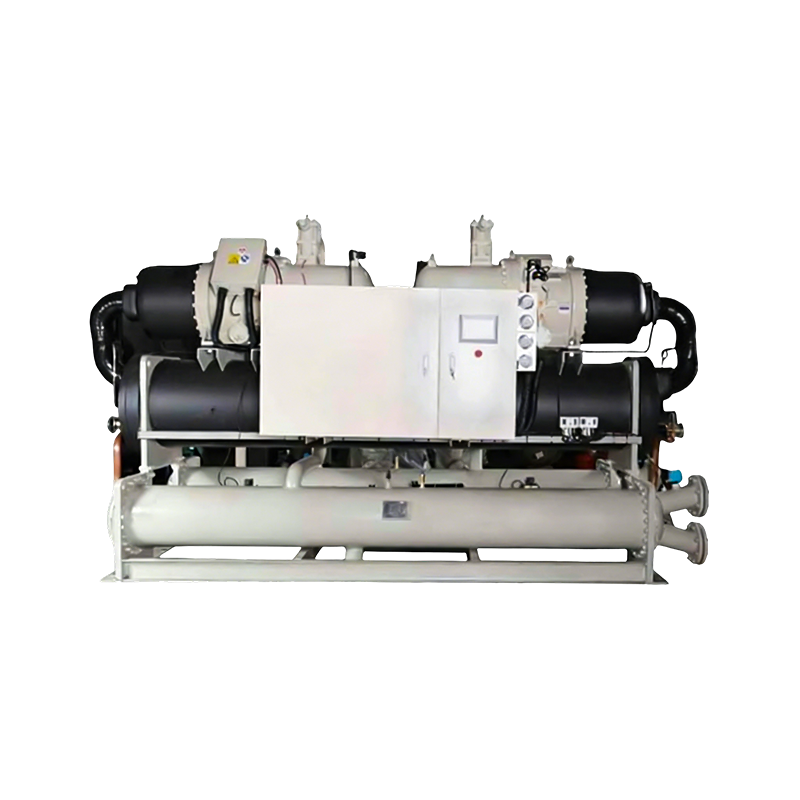
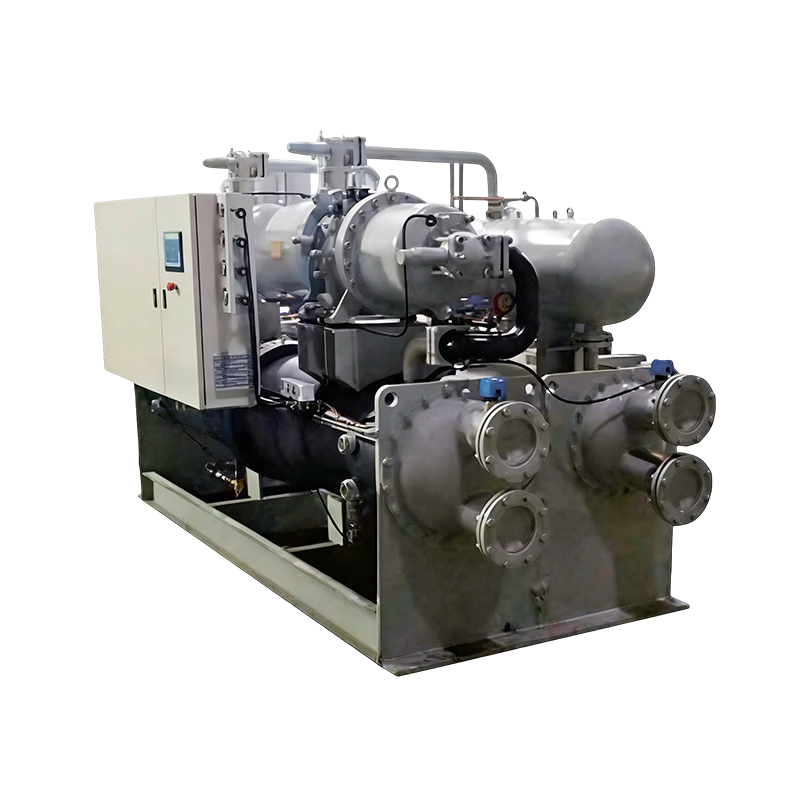 Water Cooled Screw Flooded Chiller with Electronic Expansion ValveThis flooded evaporator chiller uses a twin screw compressor and electronic expansion valve to lower compression ratio, improving energy efficiency for sustained cooling loads.View Product →
Flooded evaporators improve heat transfer by submerging the tube bundle in refrigerant, which allows a screw compressor to operate at a lower compression ratio and a higher coefficient of performance under sustained loads.
Low-GWP Refrigerants Move from Pilot Projects to Production Specifications
Low-GWP refrigerants are now the default expectation in new industrial chiller designs, driven by the Kigali Amendment schedule and by regional rules such as the European F-gas Regulation that penalize high-global-warming-potential refrigerants.
The shift is not a direct swap of one fluid for another. Refrigerants such as R-454B and R-513A carry a lower GWP than R-134a or R-410A, but most are mildly flammable and classified as A2L. That classification changes the safety architecture of the machine: refrigerant sensors, charge limits, ventilation requirements, and component approvals all have to be redesigned.
| Refrigerant | GWP | Safety class | Typical application |
| R-134a | 1,430 | A1 | Existing chillers |
| R-410A | 2,088 | A1 | Existing air-cooled chillers |
| R-454B | 466 | A2L | New air-cooled screws |
| R-513A | 573 | A1 | Retrofit and new water-cooled units |
| R-1234ze | 6 | A2L | New chillers and heat pumps |
| R-290 | 3 | A3 | Small-capacity and packaged units |
For industrial buyers, the implications are concrete. A2L machines need service technicians familiar with flammability handling, leak detection systems add another layer to the control architecture, and the charge size per circuit is limited by safety standards. These constraints favor designs that distribute the refrigerant charge across multiple smaller circuits.
The refrigerant transition is not a swap of gas in the same machine; it is a redesign of the compressor, heat exchanger, and safety architecture around a new fluid.
Smart Controls and Predictive Diagnostics Become Standard Equipment
Smart control systems have become the primary tool for unlocking part-load efficiency and preventing unplanned downtime in industrial chiller plants, rather than an optional telemetry add-on.
Modern controllers continuously compare the measured performance of each compressor against its expected efficiency curve, adjust condenser fan speeds, sequence multiple chillers in real time, and send alerts before a deviation becomes a failure.
- Automatic load prediction that pre-cools circuits ahead of production peaks
- Multi-chiller sequencing based on live efficiency curves instead of fixed rotation
- Refrigerant leak detection with immediate notification and trend logging
- Remote firmware updates and parameter tuning by the manufacturer
- Native integration with building management systems and SCADA platforms
Facility reports and industry studies consistently attribute 5 to 15 percent plant energy savings to optimized sequencing, with the highest gains in plants that run multiple chillers at partial load for long periods. Predictive diagnostics add a second benefit: they convert maintenance from a scheduled activity into a planned response, reducing emergency call-outs and production interruptions.
Predictive diagnostics are not about replacing maintenance staff; they are about telling them exactly where to look, with which spare part, and before the fault takes the line down.
When a plant has more than one chiller architecture under consideration, the selection framework matters as much as the machine. A structured comparison of load patterns, part-load behavior, and maintenance requirements is available in our guide to choosing industrial chiller units for different industrial cooling duties.
Heat Recovery Turns Condenser Rejection into a Revenue Stream
Heat recovery is changing the financial model of industrial chiller plants by converting waste condenser heat into usable thermal energy for process water, space heating, or preheating duties.
A conventional water-cooled chiller rejects about 1.2 kW of heat for every 1 kW of cooling it delivers. That heat normally goes to a cooling tower and is lost to the atmosphere. In a heat-recovery configuration, a plate heat exchanger or a desuperheater captures part of the hot gas or condenser-water stream and transfers it to a separate heating loop.
A 500 kW water-cooled chiller running at full load rejects roughly 600 kW through its condenser. Capturing 40 percent of that stream produces 240 kW of usable hot water capacity without any additional combustion.
The economics are strongest where heating demand exists year-round: food and beverage plants, pharmaceutical facilities, chemical processing, and data centers that preheat outside air. Payback periods reported in engineering studies typically fall between two and four years when the recovered heat replaces natural gas heating, and shorten when the plant needs simultaneous cooling and heating.
Without heat recovery
100 percent of condenser heat rejected to the cooling tower; a separate boiler burns fuel to produce hot water; energy paid for twice in the same building.
With heat recovery
30 to 50 percent of condenser heat diverted to a heating loop; boiler load reduced by the same amount; cooling and heating delivered from one machine.
Modular and Compact Chiller Designs Speed Up Deployment
Modular chiller configurations are displacing single massive plants in applications that need staged capacity growth, N+1 redundancy, or minimal disruption to an existing building.
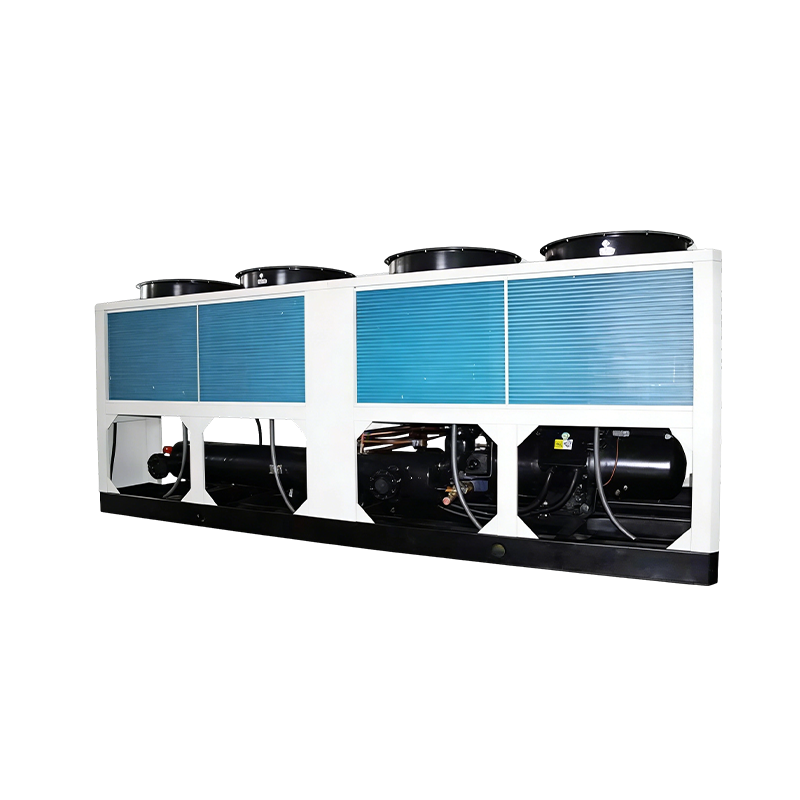
The logic is straightforward. A plant with four smaller chillers can run efficient part-load profiles across a wider range of demand, take one machine out of service for maintenance without stopping production, and grow capacity by adding a fifth unit instead of replacing everything. Factory-built frames with integrated pumps, expansion tanks, and controllers shorten site commissioning from weeks to days.
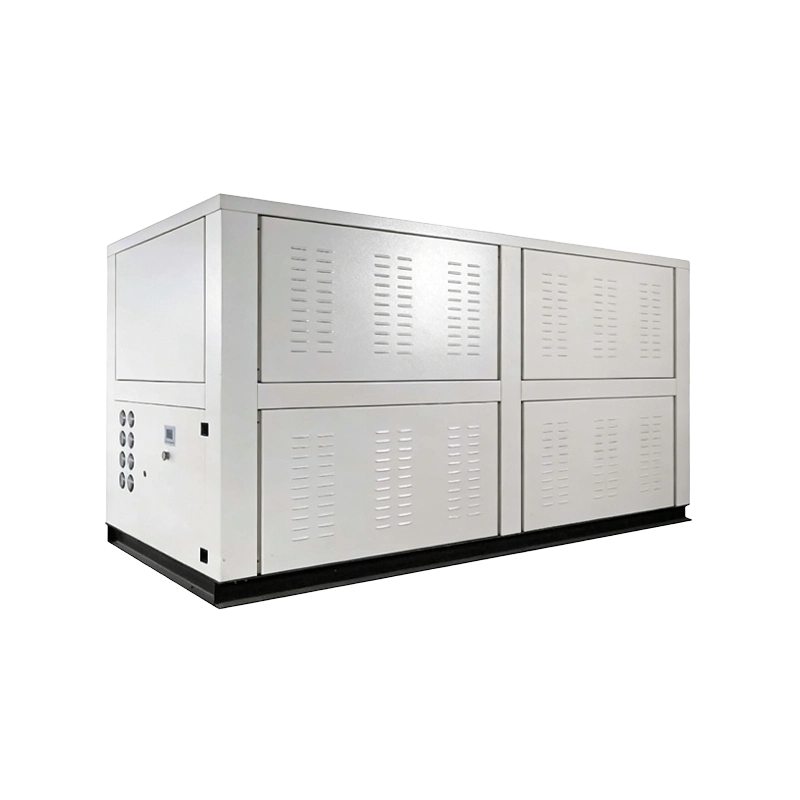
For facilities that need a self-contained cooling source without a dedicated chiller room, Shanghai Soouney Refrigeration Equipment Co., Ltd. builds a range of cabinet-style packages that integrate the complete refrigeration circuit into one footprint.
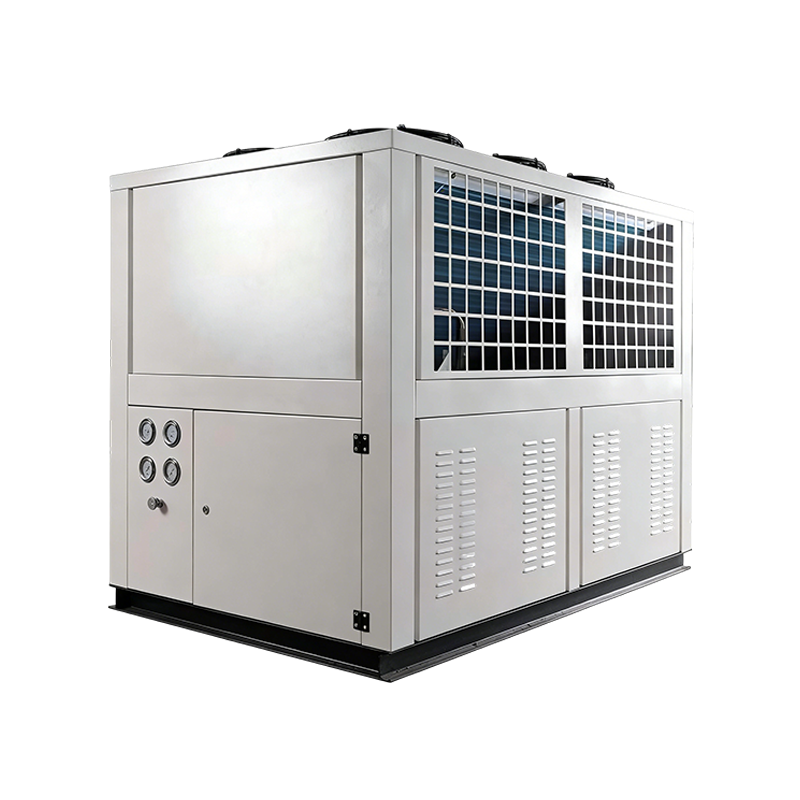 Air Cooled Box Chiller for Compact Self-Contained CoolingA cabinet-style air cooled chiller integrating the complete refrigeration circuit, suited for facilities without a dedicated chiller room and offering simplified installation.View Product →
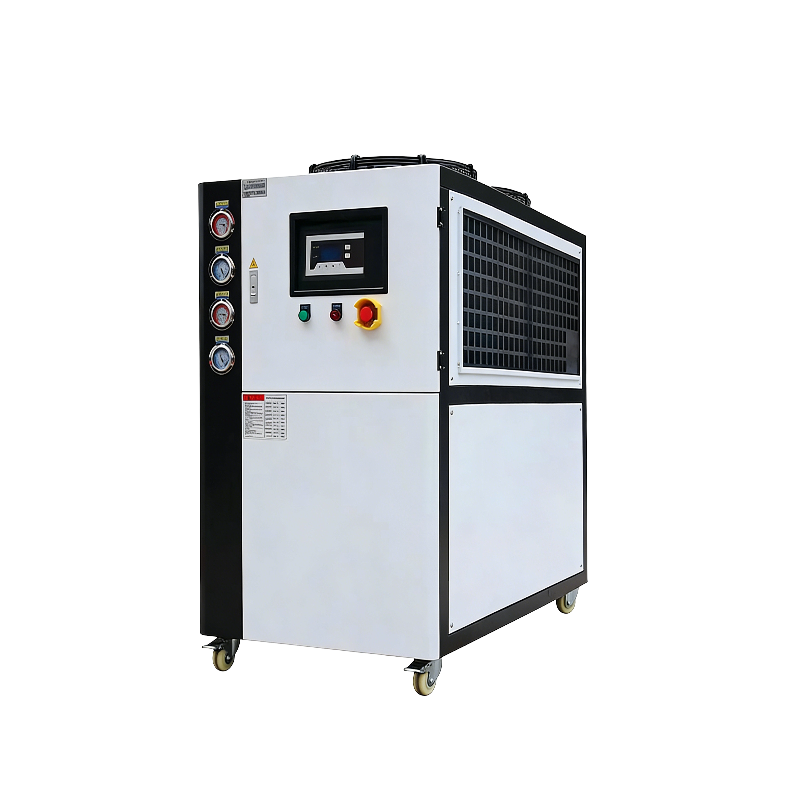
Where floor space is the limiting factor, the compact integrated chiller platform combines hydronics and control in a single enclosure designed for low noise and simplified installation.
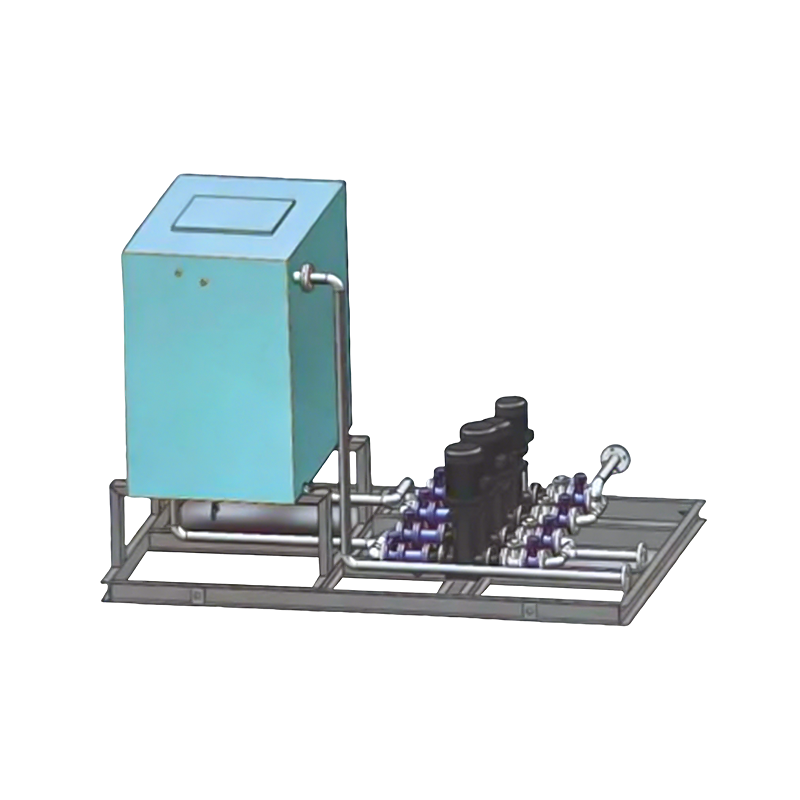 Integrated Chiller with Hydraulic Module for Space-Saving InstallationThis unit combines chiller, pumps, cooling tower, and piping into one compact package, reducing floor space and enabling rapid deployment with low noise operation.View Product →
Modularity also supports the low-GWP transition in a subtle way: distributing the refrigerant charge across smaller circuits keeps each charge below the thresholds defined by A2L safety standards while preserving the total cooling capacity the plant needs.
A modular installation separates refrigerant into smaller circuits, which simplifies A2L compliance and reduces the refrigerant volume at risk from any single leak.
Frequently Asked Questions
The following questions cover the decisions that facility teams are facing as the 2026 refrigerant and efficiency rules settle into daily operation.
What is the biggest trend in industrial chiller technology in 2026?
The largest trend is the convergence of low-GWP refrigerants with digital control platforms. A new industrial chiller in 2026 is expected to run on a refrigerant with a GWP below 700, communicate with plant-level management systems, and sustain high efficiency across a wide part-load band.
Are low-GWP refrigerants compatible with existing chiller installations?
Retrofitting an existing chiller from R-134a or R-410A to a low-GWP alternative depends on the compressor, oil, and component pressure ratings. Some refrigerants are marketed as drop-in replacements, but efficiency, capacity, and safety classification will shift. For most industrial chillers, the practical path is to specify low-GWP refrigerants on new equipment and evaluate retrofits case by case with the manufacturer.
How much can smart controls reduce chiller energy use?
Typical savings from optimized sequencing and load prediction range from 5 to 15 percent of plant energy consumption. Plants with multiple chillers operating under partial loads for long periods see the upper end of that range.
When should an industrial facility choose a modular chiller layout over one large machine?
Modular layouts make sense when cooling loads grow in phases, when redundancy requirements exceed the practical capability of a single machine, when installation access is limited, or when refrigerant charge limits make smaller circuits preferable.