
 English
 Español
Content
Selecting the wrong outdoor cabinet air conditioner for a telecom enclosure, industrial control panel, or roadside electrical cabinet is not a minor miscalculation — it means overheated electronics, shortened component lifespans, and unplanned downtime. This guide answers the four questions engineers and facility managers ask most often: how much cooling capacity is actually needed, what to look for when comparing units, which models hold up in extreme heat, and what energy efficiency numbers really mean in practice.
What Cooling Capacity Does an Outdoor Cabinet Actually Require
The required cooling capacity is determined by the total heat load inside the enclosure, not by cabinet size alone. Every active component — power supplies, PLCs, drives, communication modules — generates waste heat that must be removed to maintain safe operating temperatures, typically below 35°C for most electronics.
Solar radiation through an uninsulated steel cabinet wall facing direct sun adds between 150 and 400 watts per square meter of exposed surface — a figure most estimators undercount. A 600 mm x 600 mm top panel in full summer sun contributes up to 144 W before a single internal component is switched on. Always calculate solar gain separately and add it to the measured or rated internal heat dissipation of installed equipment.
How to Choose an Outdoor Cabinet Air Conditioner: 5 Selection Criteria
Choosing an outdoor cabinet air conditioner requires evaluating five criteria in sequence. Skipping any one of them produces a unit that either fails prematurely or consumes excessive energy for the duty it performs.
Outdoor units must carry a minimum IP55 rating — dust-tight and protected against water jets from any direction. Coastal or high-humidity environments require IP56 or IP65. An IP54-rated unit will fail within 12–18 months in a tropical outdoor installation.
Standard units are rated to operate in ambient temperatures up to 45°C. For Middle Eastern, Sub-Saharan African, or Australian outback installations where ambient temperatures reach 55°C, high-temperature-rated units are mandatory — not optional upgrades.
Match the unit's rated cooling output (in watts or BTU/h) to the calculated cabinet heat load plus the 20% safety margin. A 1,000 W unit installed in a 1,200 W heat load environment runs continuously at 100% duty cycle, tripling wear on the compressor.
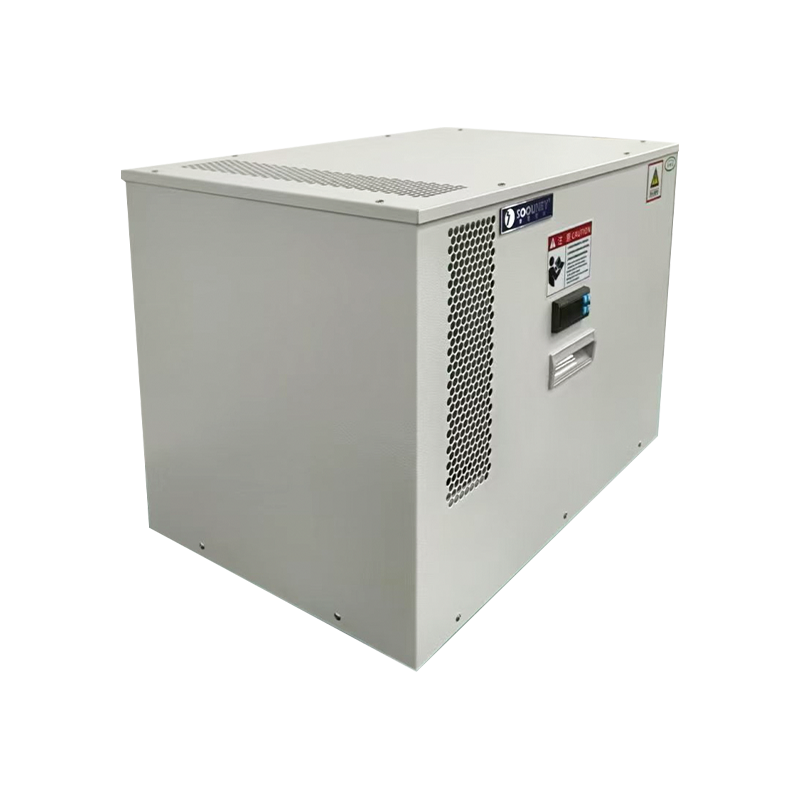
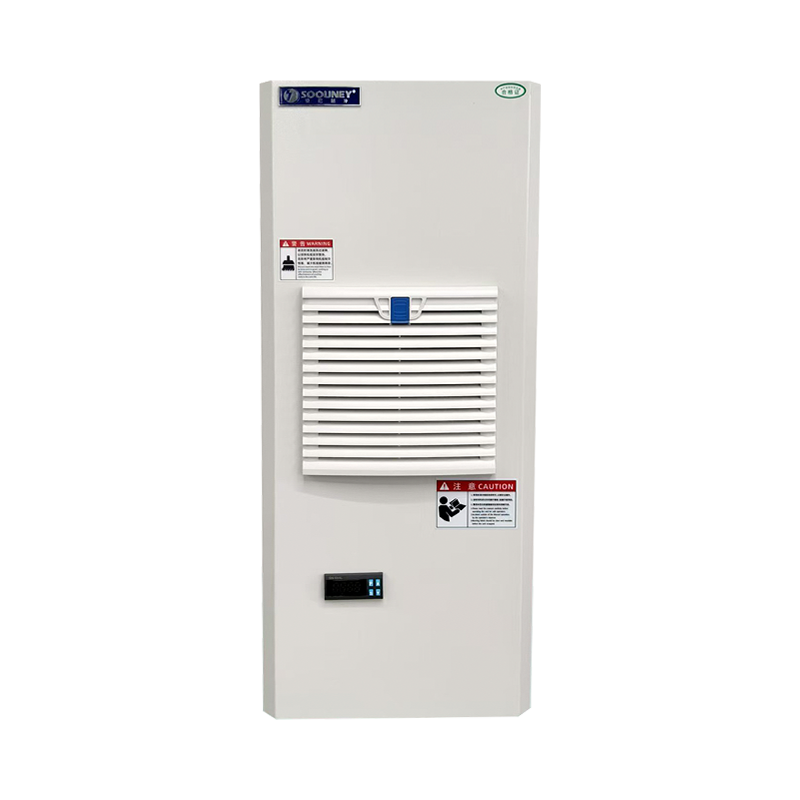
Side-mount, top-mount, and through-door configurations each have different condensate drainage requirements and vibration profiles. Side-mount units are most common for telecom and power distribution cabinets; top-mount suits equipment with strict airflow direction requirements.
R410A and R32 refrigerants are the current industry standards for outdoor cabinet units. R32 has a global warming potential (GWP) of 675 — roughly one-third of R410A at 2,088 — making it the preferred choice for projects with sustainability mandates or EU F-Gas compliance requirements.
Which Outdoor Cabinet Air Conditioner Works in High Temperatures
Standard cabinet air conditioners begin to lose cooling efficiency when ambient temperatures exceed 40°C and typically shut down on high-pressure protection above 45°C. High-temperature-rated units use enhanced condenser coil designs, variable-speed compressors, and sub-cooling circuits to maintain full cooling output up to 55°C ambient.
| Unit Type | Max Ambient Temp | Capacity Retention at Max Temp | Typical Application |
| Standard outdoor unit | 45°C | 85–90% of rated output | Temperate climates, shaded installations |
| High-temp rated unit | 55°C | 95–100% of rated output | Desert, tropical, direct-sun roof installations |
| Variable-speed inverter unit | 52°C | 100% with adaptive compressor speed | Energy-sensitive grid-edge and solar-powered cabinets |
| Freecooling hybrid unit | 55°C (compressor mode) | Full output; passive mode below 20°C ambient | Regions with large day/night temperature swings |
In regions where daytime ambient temperatures consistently exceed 48°C — including parts of Saudi Arabia, India, and Australia — freecooling hybrid units provide the best combined performance. They operate in passive air-to-air heat exchange mode during cooler nighttime hours (eliminating compressor energy use entirely) and switch to active refrigeration during peak daytime heat, reducing annual compressor run hours by 30–50%.
How Energy Efficient Are Outdoor Cabinet Air Conditioners
Energy efficiency in outdoor cabinet air conditioner units is expressed as the Energy Efficiency Ratio (EER) — the ratio of cooling output in watts to electrical input in watts. A higher EER means less electricity consumed per watt of heat removed.
For a 1,000 W cabinet air conditioner running 8,760 hours per year, upgrading from EER 2.0 to EER 3.5 saves approximately 2,100 kWh annually — equivalent to reducing electricity costs by USD 250–420 per unit per year at typical industrial tariffs. Across a deployment of 100 cabinets, that differential funds the premium cost of high-efficiency units within 18 to 24 months.