
 English
 Español

Content
- 1 Cooling capacity comes from the heat load, not the cabinet volume
- 2 The unit becomes part of the enclosure, so its rating must match
- 3 Mounting position sets clearance, weight and service access
- 4 Condensate, filtration and control decide the service life
- 5 Efficiency and running cost depend on the cooling principle
- 6 What to confirm before the purchase order
A 1,200 W variable frequency drive inside a sealed 1.5 m by 0.8 m by 0.4 m painted steel cabinet drives the internal air to roughly 96 °C on a 45 °C day if nothing cools it. At a 35 °C setpoint the same walls remove no heat at all: they add about 233 W, because the outside air is warmer than the cabinet.
That single calculation decides the capacity bracket and most of the price. The protection rating, mounting position, condensate route, control method and service access decide whether the unit is still running in year eight.
The sequence below is the one we use when a buyer sends cabinet drawings: heat load first, then protection rating, mounting, condensation and controls, efficiency, and finally the documents to request before the purchase order.
Cooling capacity comes from the heat load, not the cabinet volume
Required cooling capacity equals the watts dissipated inside the enclosure plus the watts transferred through its walls, multiplied by a safety margin; cabinet volume does not enter the calculation at all.
Worked through on the opening case: 1,200 W of internal losses, 4.24 square metres of painted steel, 45 °C ambient against a 35 °C setpoint.
The total lands at 1,720 W, about 5,870 BTU/h, so a nominal 1,800 W unit covers it with the margin intact. Sizing to 1,200 W instead leaves the cabinet at 45 °C internally: at the 40 °C ambient limit most drives are specified for, with no reserve left for a second heat source or a warmer summer.
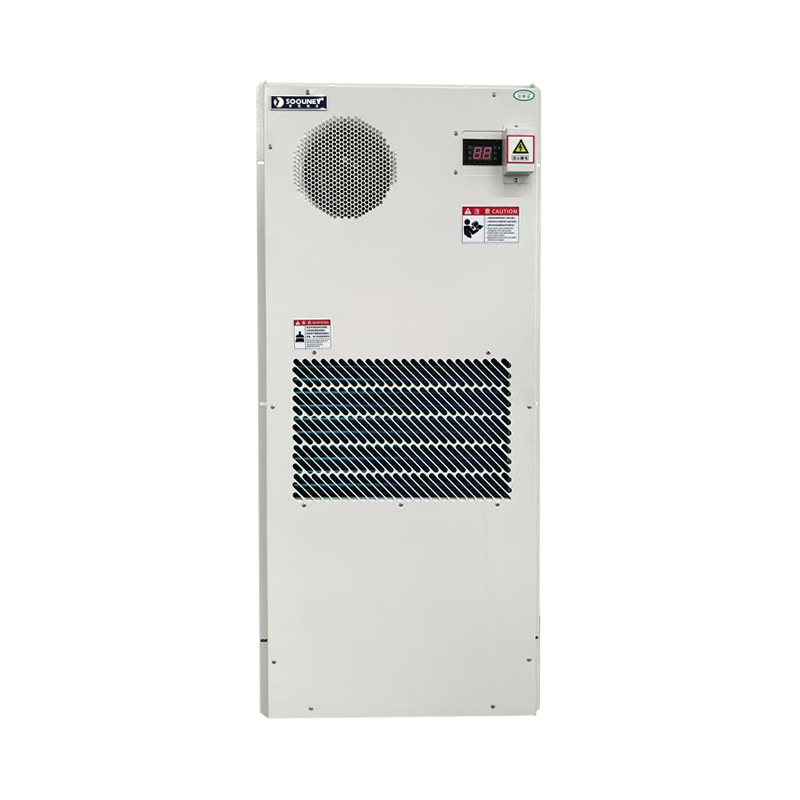
High ambient sites need a unit rated for the ambient, not only for the load. Compressor capacity falls as condenser inlet temperature climbs, so the capacity table has to be read at the real site condition rather than at a 35 °C laboratory rating. Units built for high temperature electrical cabinets are specified against those conditions from the start.
 High-Temperature Electrical Cabinet Air Conditioner for Extreme EnvironmentsBuilt for ambient temperatures up to 65°C with R134A refrigerant, Hitachi compressors, EBM fans, dual-layer filtration, IP55 enclosure and corrosion-resistant epoxy-coated coils.View Product →
The unit becomes part of the enclosure, so its rating must match
A cabinet air conditioner cut into an enclosure wall becomes part of that enclosure, so its gasket, housing and drain must meet or exceed the IP or NEMA rating of the cabinet it serves.
The IP code is defined in IEC 60529 and NEMA enclosure types in NEMA 250. For cabinet cooling the practical mapping is short.
| Rating | Typical location | Protects against | Selection note |
| IP54 | Indoor, dusty plant | Dust protected, splashing water | Standard indoor electrical and PLC cabinets |
| IP55 | Washdown bays, roofed outdoor | Dust protected, water jets | Needs a sealed cutout gasket and a routed drain |
| IP65 | Exposed outdoor, food and beverage | Dust tight, water jets | Confirm housing, fan cover and drain all carry the rating |
| NEMA 12 | Indoor | Dust, falling dirt, dripping liquid | Not suitable for outdoor mounting |
| NEMA 4 / 4X | Outdoor, coastal or chemical air | Rain and hose-directed water; 4X adds corrosion resistance | 4X for salt air, pulp mills and fertilizer plants |
Two mistakes recur. Fitting an IP54 unit to an IP65 cabinet drops the whole assembly to IP54, because the weakest component sets the rating. Mounting an outdoor-rated housing on a door that was never sealed lets water in around the cutout rather than through the unit.
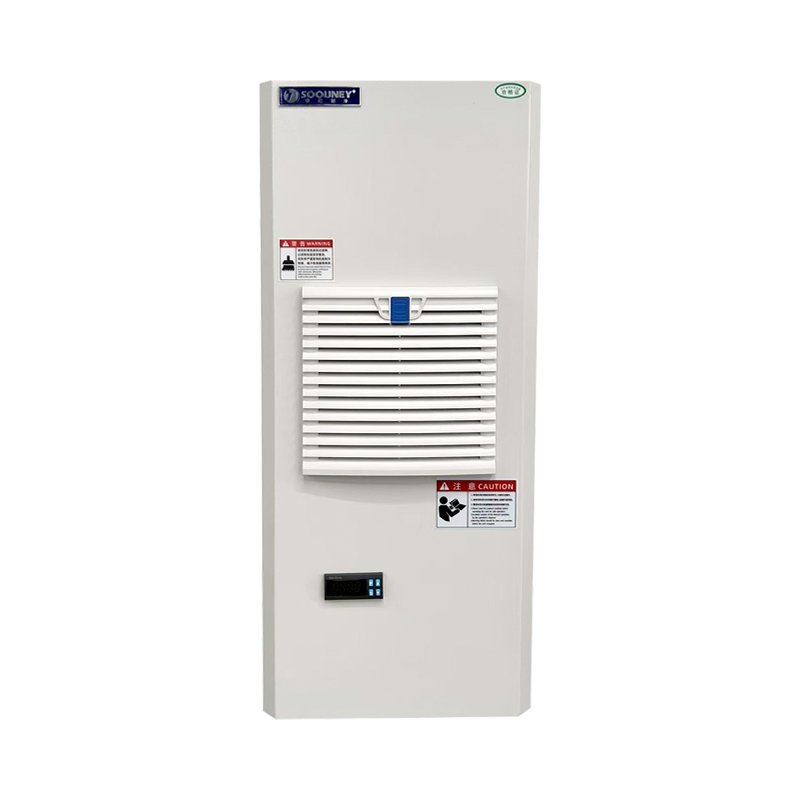
Where hose-directed cleaning is routine, the unit itself has to carry that rating. The IP55 cabinet air conditioners built for those lines use sealed cutouts and a ducted condenser path so the cabinet stays closed while the heat leaves.
IP55 cabinet air conditioners are the usual answer for washdown areas; the same logic applies to every other rating level.
Outdoor installations add solar gain and wind-driven rain. A unit rated for the enclosure is not automatically rated for the weather, so check the housing, the fan guard and the condensate drain for UV exposure and freeze risk.
 Outdoor Electrical Cabinet Air Conditioner with IP55 ProtectionClosed-loop cooling for outdoor enclosures from -40°C to +55°C, with 300–2500 W capacities, side or roof mounting, and optional freeze protection.View Product →
Mounting position sets clearance, weight and service access
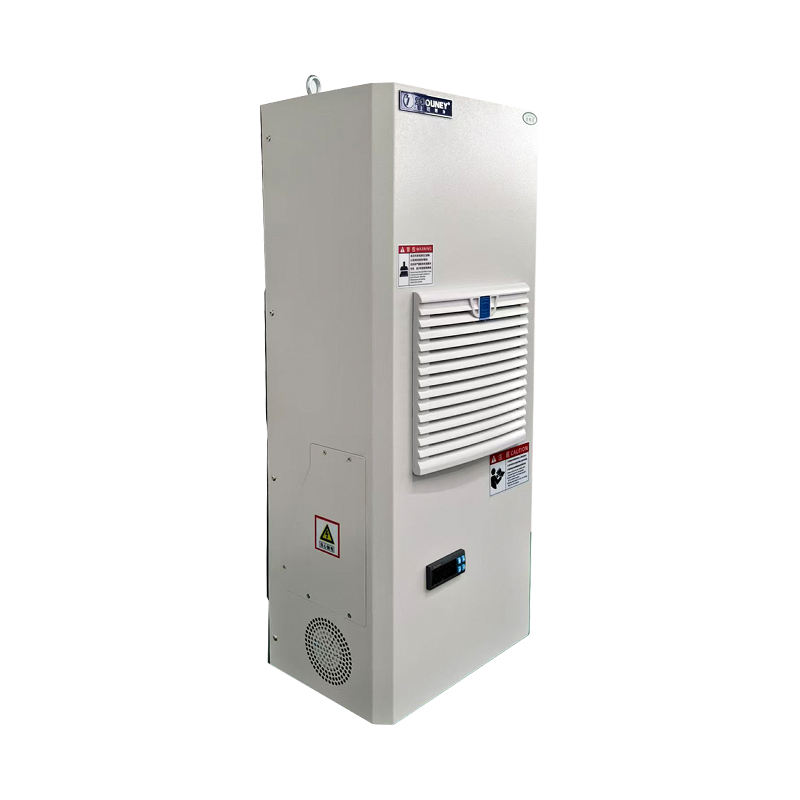
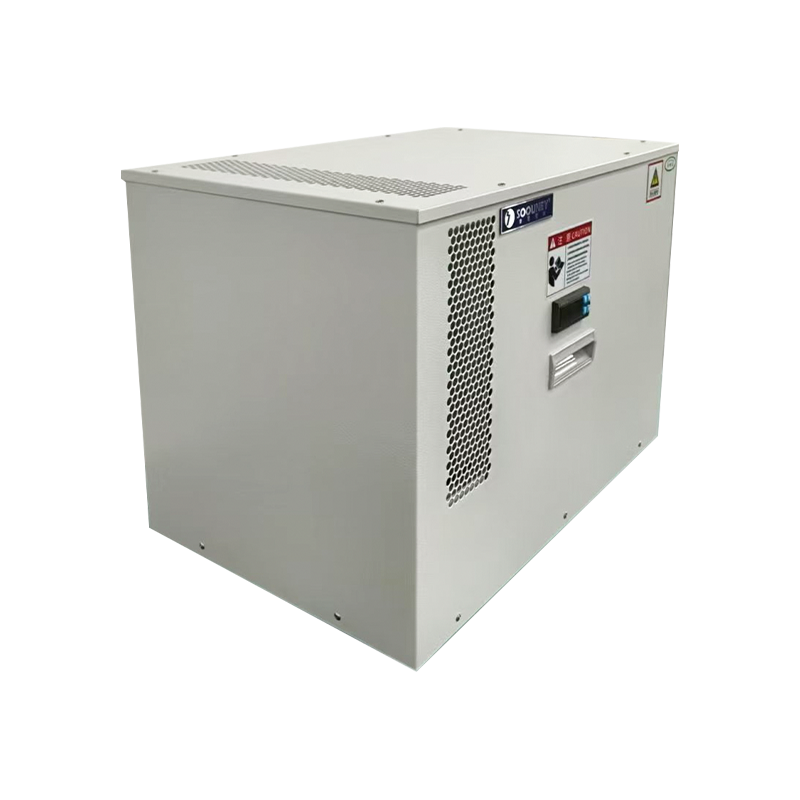
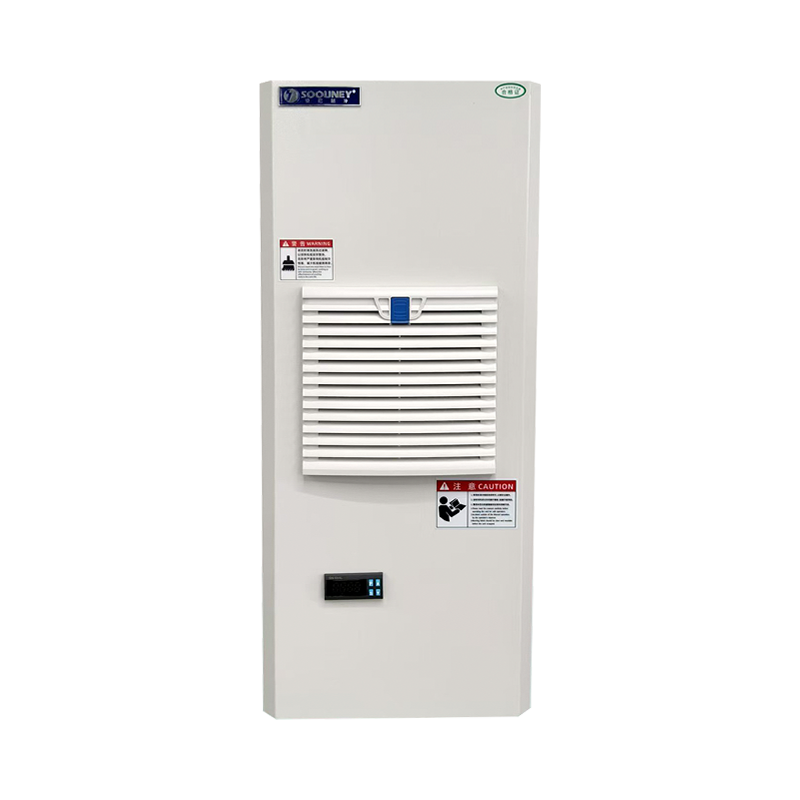
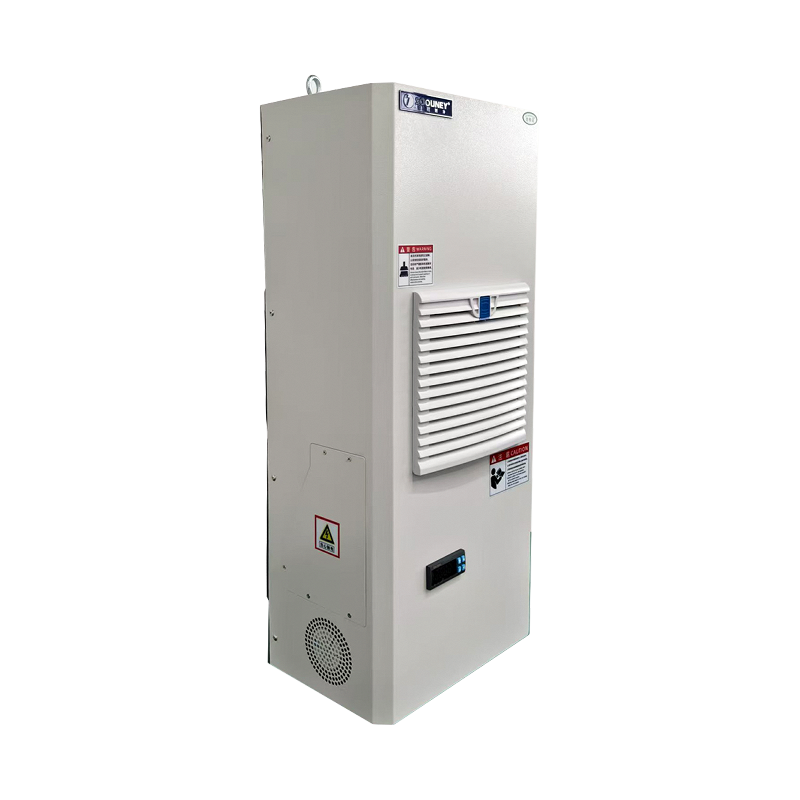
Side and door mounting suit retrofits, top mounting frees wall space and lifts the unit above standing water, and slim or recessed forms exist for prefabricated cabins where the skin cannot be cut deep.
- Door mounting puts the unit mass on the hinges. A 40 kg unit on a 1.2 m door adds a moment the hinges were not specified for; check the door rating or move the unit to a side panel.
- Side mounting needs free space in front of the condenser intake. Plan at least 200 mm of clearance and keep the exhaust away from hot pipework or another cabinet.
- Top mounting adds 300 mm to 500 mm of height, needs lifting access and places the unit in the hottest air layer of the building. It suits outdoor skids and cabins whose wall space is taken by cable entries.
- Service access decides long term reliability. The filter and drain must be reachable without removing the unit or opening the cabinet door under power.
Condensate, filtration and control decide the service life
A compressor-based cabinet air conditioner produces condensate whenever the evaporator coil runs below the dew point of the internal air; that water must leave the cabinet through a routed drain, or it ends up on the terminals.
Three details separate a reliable installation from a repeat service call:
- Drain slope and freeze protection. A drain that runs uphill or into a trap full of debris backs water into the cabinet. In freezing climates the line needs heat trace or a freeze-protected route.
- Anti-condensation control. In humid plants the failure mode is condensation inside the cabinet during ambient swings, not overheating. A heater circuit or a dual setpoint holds the internal air above dew point.
- Filter service. A clogged condenser filter cuts capacity and raises discharge temperature. Specify a filter that can be cleaned without tools and fix the interval in the maintenance plan.
Where condensation inside the cabinet rather than heat is the failure mode, the unit has to run a heating and circulation cycle as well as a cooling one.
 Non-Condensing Cabinet Air Conditioner with Dew-Point ControlPrevents internal condensation using dew-point tracking and a dry-cooling circuit, with digital monitoring, Modbus communication and potential-free alarm contacts for sensitive electronics.View Product →
Controls decide how the unit behaves unattended. A mechanical thermostat is enough for one cabinet. A digital controller with a dry alarm contact lets the PLC see a cooling failure before the drive trips. Remote monitoring over Modbus or SNMP belongs on cabinets that are hard to reach, not on every unit in a plant.
Efficiency and running cost depend on the cooling principle
An air-to-air heat exchanger uses less energy than a compressor unit but cannot cool below ambient; a compressor cabinet air conditioner holds a setpoint below ambient and pays for it in energy and maintenance.
Air-to-air heat exchanger
- No compressor, so fan power only
- Works while ambient stays below the internal setpoint
- Keeps plant dust out when the internal circuit stays closed
- Cannot hold 35 °C inside when the outside air reaches 45 °C
Compressor cabinet air conditioner
- Holds 35 °C inside at 45 °C ambient
- Capacity falls as ambient rises, so read the derating curve
- Needs a drain, filter service and refrigerant handling
- Higher purchase price and higher running cost
Running cost is arithmetic once the duty is known. A unit drawing 700 W for 4,000 hours a year uses 2,800 kWh; a 500 W unit on the same duty uses 2,000 kWh. At a stated tariff of 0.15 USD per kWh the gap is 120 USD a year, so a 300 USD price difference closes in about two and a half years, before any maintenance saving is counted. Substitute the local tariff and the measured duty cycle and the same comparison holds.
What to confirm before the purchase order
Four numbers decide most of the quote: internal heat load in watts, maximum ambient in °C, enclosure surface area and the required IP or NEMA rating; everything else is drawings and nameplate data.
- List heat sources at their simultaneous load, not the nameplate sum. A drive running at 60% output does not dissipate its full rated loss.
- State maximum and minimum ambient. Cooling capacity and heater sizing both depend on the range.
- Give enclosure dimensions, material, paint colour and whether it stands in direct sun. Surface area drives the wall transfer term.
- Confirm supply voltage, phase, frequency and available circuit protection.
- Mark the mounting face and the free space around it on the drawing, including door swing, cable entries and lifting access.
- Ask for the capacity table at the actual ambient, the refrigerant designation, the IP or NEMA test basis and the alarm contact rating. A quote without a derating table cannot be compared with one that includes it.
Send cutout size, heat load, maximum ambient and required IP rating in the same message. A quote built on those four numbers can be compared line by line; a quote built on cabinet size alone cannot.
Comparing several suppliers is easier when every offer is built on the same basis. Shanghai Soouney Refrigeration Equipment Co., Ltd. organises its industrial cabinet air conditioner range by mounting position and protection rating, which makes that side-by-side comparison straightforward.
How many watts of cooling does a sealed cabinet need?
Add the internal dissipation to the wall transfer term U x A x dT, using 5.5 W/m2K for painted steel, then apply a 20% margin. A 4.24 m2 cabinet holding 35 °C in 45 °C ambient needs 1,433 W before the margin and about 1,720 W after it, which a nominal 1,800 W unit covers.
Can a cabinet air conditioner be mounted on the enclosure door?
Yes, provided the hinges and door stiffener are rated for the mass. Units in the 25 kg to 60 kg range are common, and a door that sags under that load breaks the gasket seal and the IP rating with it. When the door rating is unknown, mount on the side panel or add a stiffening frame.
Does fitting an air conditioner keep the enclosure sealed?
Only when the unit and its cutout gasket carry the same IP or NEMA rating as the cabinet. An IP54 unit on an IP65 enclosure sets the whole assembly to IP54. Closed-loop cooling keeps the internal air circuit separate from plant air, which is the reason to choose it over filtered fans in dusty areas.
How often should the condenser filter and drain be checked?
Inspect the condenser filter every 4 to 8 weeks in dusty plants and clean or replace it; check the drain on the same visit. Clean the coils and test the alarm contact once a year. A blocked filter or a dry trap shows up as a unit that runs continuously without holding the setpoint.