
 English
 Español
Content
Industrial Process Cooling Guide
The production floor is at full load, the plant cooling loop has no spare capacity, and a new injection molding line needs 45 kW of steady process cooling within one month. There is no cooling tower, no water-treatment budget, and almost no indoor floor space. An air-cooled industrial chiller solves this scenario directly: it arrives as a packaged refrigeration unit, sits outdoors, connects to the process loop with two flanges, and delivers chilled water the moment the power cable is landed.
This guide covers the principal applications of air-cooled industrial chillers, compares them with water-cooled alternatives, and walks through the sizing decisions that separate a dependable installation from a chronic maintenance problem.
What an Air-Cooled Industrial Chiller Does
An air-cooled industrial chiller is the most water-independent way to remove process heat at industrial scale, because it rejects condenser heat to ambient air instead of to a cooling tower or municipal water loop.
In a typical machine, a scroll or screw compressor drives a vapor-compression cycle. The evaporator absorbs heat from the process water and lowers it to setpoint, the compressor raises the refrigerant pressure, and the air-cooled condenser releases the heat through finned coils while fans pull ambient air across the coil surface. The chilled water loop carries the cooled fluid to molds, laser optics, reactor jackets, or hydraulic oil coolers, and returns it to the evaporator.
An air-cooled industrial chiller is a packaged refrigeration system in which the condenser rejects heat directly to ambient air, producing chilled water or water-glycol for process cooling without a separate cooling water supply.
- Standard leaving water temperature spans 5-15°C for most process applications.
- No cooling tower, no water treatment, and no makeup water line are required.
- Packaged construction lowers installation labor compared with field-erected water-cooled plants.
- Condenser sections are designed for outdoor installation on slabs or rooftops.
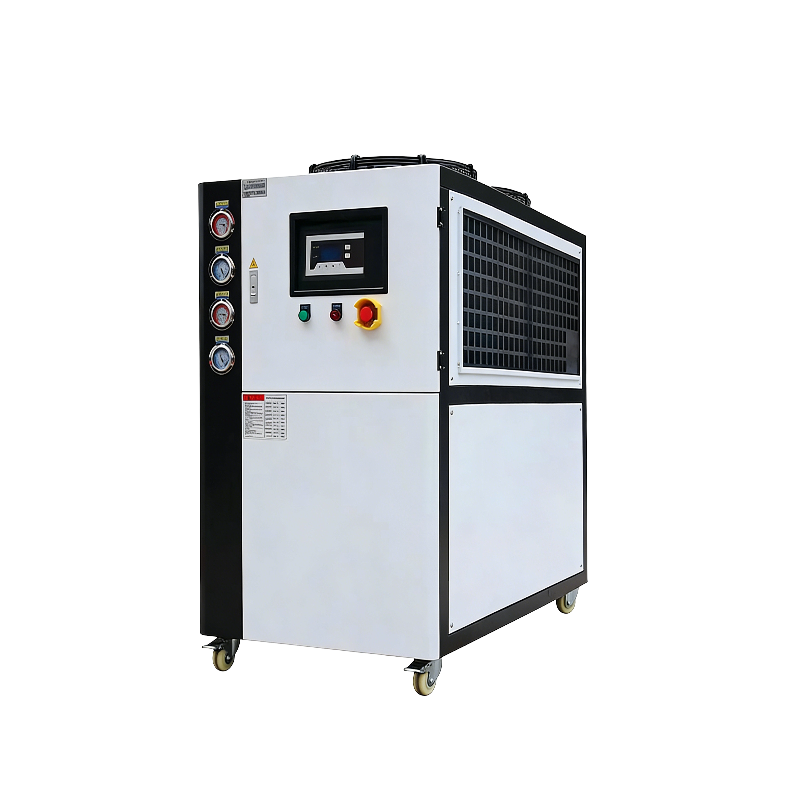
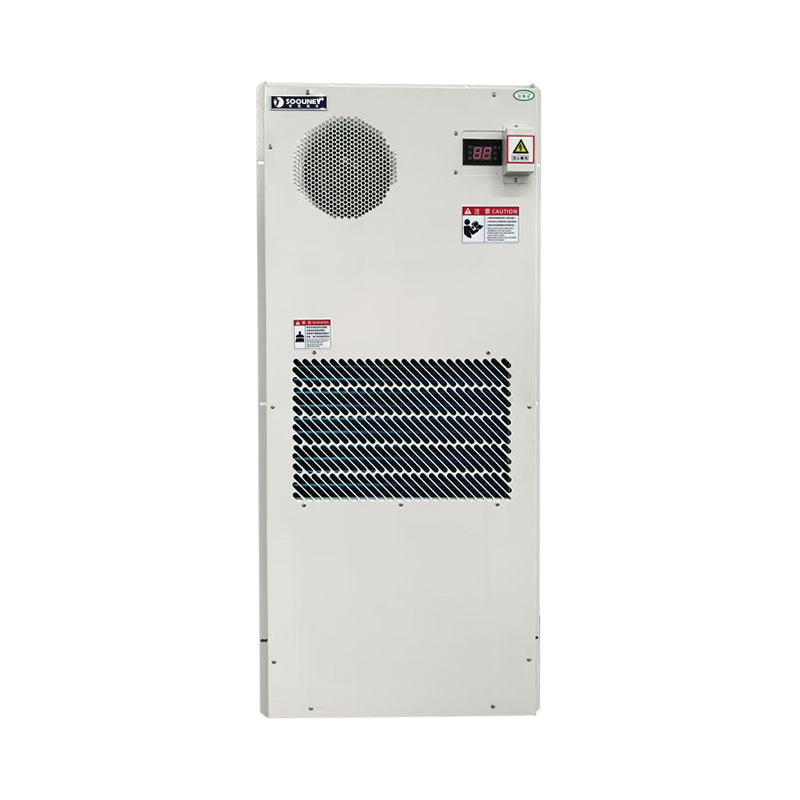
For compact process loads, Shanghai Soouney Refrigeration Equipment Co., Ltd. builds the air-cooled box chiller range, which combines compressor, condenser, pump, tank, and controls in one footprint, shortening the connection between chiller and production line.
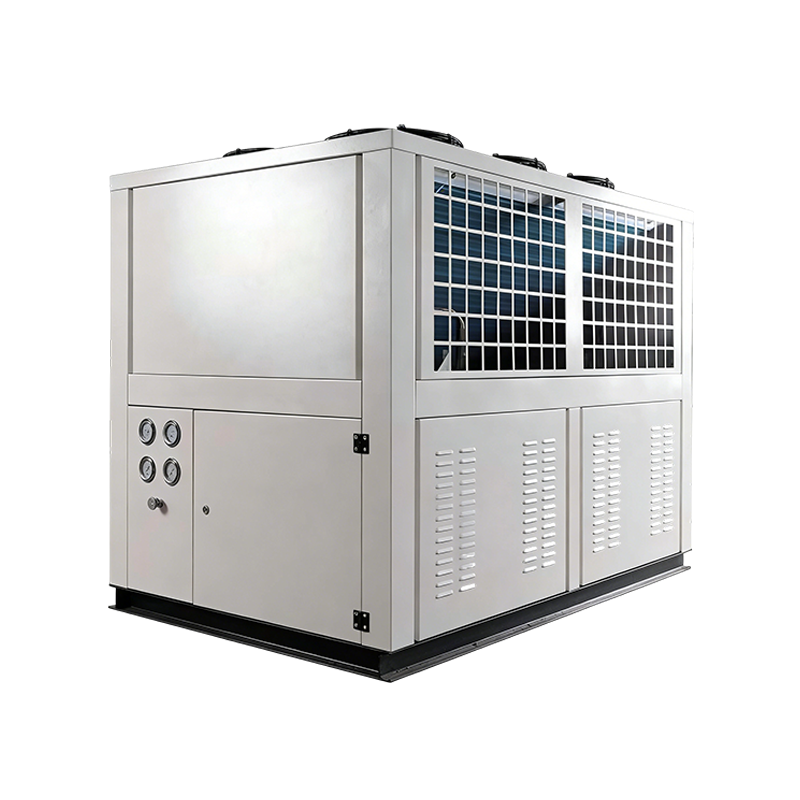 Custom Air Cooled Box Chiller Manufacturers, FactoryWe Are China Air Cooled Box Chiller Manufacturers, Factory, Shanghai Soouney Refrigeration Equipment Co., Ltd. Offer Custom Air Cooled Bo...View Product →
Main Application Areas Across Industry
Air-cooled industrial chillers are the default choice wherever process heat must be removed but water is scarce, expensive, or unavailable, and that condition appears in more industries than most engineers expect.
Six application groups account for the majority of installed air-cooled chiller capacity in the small- to medium-plant segment:
- Plastics and injection molding. Mold cooling at 8-15°C shortens cycle time and reduces warpage; cooling commonly represents half of the total molding cycle.
- Laser and welding systems. Laser cavities, optics, and weld torches need clean water at 20-25°C with stable flow; a dedicated chiller isolates the laser from plant-loop contamination.
- Chemical and pharmaceutical reactors. Jacket cooling, solvent condensation, and crystallization require reliable 0-15°C fluid, with low-temperature packages for subzero duties.
- Food and beverage processing. Rapid chilling of jacketed tanks and line components keeps product temperature under control without cross-connecting the utility loop.
- Machine tools and hydraulic systems. Spindle motors, CNC drives, EDM machines, and hydraulic oil reject heat that directly affects machining accuracy.
- Electronics and test laboratories. RF generators, test fixtures, semiconductor tools, and environmental chambers produce heat spikes that a chiller absorbs without hunting.
Where air-cooled chiller capacity goes
Representative distribution based on typical installed systems in small- and medium-sized plants.
Plastics and laser processes make up nearly half of installed capacity because cooling directly controls cycle time and part quality in those industries; the decision is usually settled by scrap rate and throughput, not by the chiller price alone.
In chemical and pharmaceutical duty where the leaving temperature falls below standard limits, a low-temperature package such as Soouney's ambient-temperature cryogenic air-cooled chiller extends the same air-cooled simplicity to subzero process cooling.
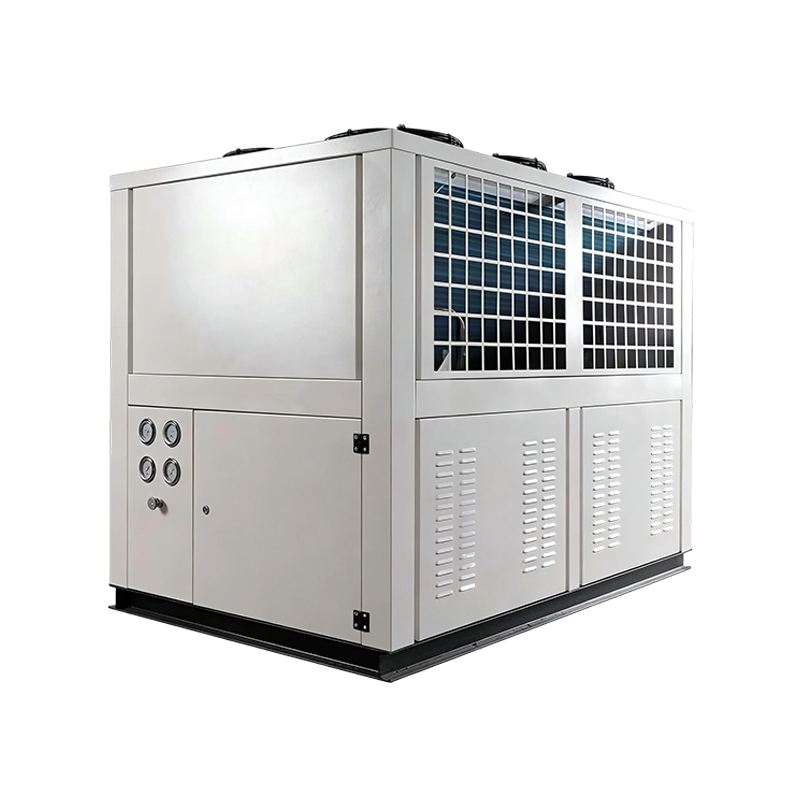 Wholesale Ambient Temperature Cryogenic Air Cooled Chiller Suppliers, Company, EShanghai Soouney Refrigeration Equipment Co., Ltd. Is China Wholesale Ambient Temperature Cryogenic Air Cooled Chiller Suppliers, Company...View Product →
For a deeper look at matching the machine to the actual cooling duty, read this guide to choosing industrial chiller units for different industrial cooling.
Air-Cooled versus Water-Cooled Chillers
Choose an air-cooled industrial chiller when water is a constraint, installation time is short, or the plant has no existing tower loop; choose water-cooled only when very large loads and long operating hours justify the extra infrastructure.
Choose air-cooled when
- No cooling water, cooling tower, or water-treatment system exists on site.
- Installation has to be complete in weeks, not months.
- The capacity demand sits in the 50-300 kW band.
- The plant wants a single packaged machine with straightforward maintenance.
Choose water-cooled when
- Loads run above roughly 500 kW for many hours per day.
- Energy price dominates the operating cost calculation.
- A cooling tower and a treated water loop already exist.
- Outdoor hot-air discharge or condenser noise is a site problem.
| Parameter | Air-cooled | Water-cooled |
| Heat rejection | Finned coils and fans to ambient air | Cooling tower plus water loop |
| Water consumption | Zero makeup water | Continuous evaporation and blowdown |
| First cost, 100-300 kW | Lower, one package | Higher with tower, pumps, treatment |
| Full-load EER | 2.8-3.8 | 4.0-5.8 |
| Maintenance workload | Coil cleaning and fan checks | Tower cleaning, water chemistry, pump service |
| Best-fit range | Up to a few hundred kW | 500 kW and above |
In the 50-300 kW band, where most plastics, laser, chemical, and machine-tool plants operate, air-cooled units generally win on combined first cost and simplicity. Above that band, with long operating hours, water-cooled systems start to overtake on energy alone.
Sizing and Selection in Five Steps
The hydraulic formula is the foundation. For a water loop, Q (kW) equals flow (L/s) multiplied by 4.18 and by the temperature difference in °C. If a process needs 12 L/s cooled from 12°C to 7°C, the heat load is 12 x 4.18 x 5, or 251 kW. That is the number the chiller must absorb before any margin is applied.
- Calculate the process heat load in kilowatts from machine nameplates or from flow, specific heat, and temperature difference.
- Set the leaving chilled water temperature: 7°C is the default, molds often run at 10-15°C, and anything below 5°C requires glycol and a low-temperature model.
- Choose the design ambient from the warmest summer month, typically 35°C; high-ambient sites need a larger condenser or a high-ambient model.
- Apply a 10-20% capacity margin for pump heat, process variation, and coil fouling.
- Verify evaporator flow and pressure drop against the pump curve, including the installed pipe length and fittings.
For owners of large continuous loads, this air-cooled screw chiller versus centrifugal chiller guide explains where the two machine families overlap and where they diverge.
Operating Constraints and Maintenance Facts
Most air-cooled chiller service failures start with airflow and water chemistry, not with the compressor; most downtime is preventable through layout discipline and a scheduled maintenance routine.
- Keep at least 1 m of clearance on the condenser air inlet and 1.5-2 m on the discharge side.
- Avoid clustering units so that hot discharge air recirculates into adjacent condenser intakes.
- Clean finned condenser coils two to four times per year, depending on dust and pollen load.
- Confirm low-ambient controls, such as fan cycling or condenser pressure control, before winter operation.
- Use inhibited glycol when the leaving water temperature falls below 5°C, at a concentration matched to the coldest expected ambient.
- Log high head pressure and low suction alarms monthly; a slow rise in head pressure indicates coil fouling or refrigerant loss.
Startup checklist
Verify voltage balance within 2%, confirm fan rotation direction, prove the flow switch, and run the machine at part load for one hour while logging suction and discharge pressures.
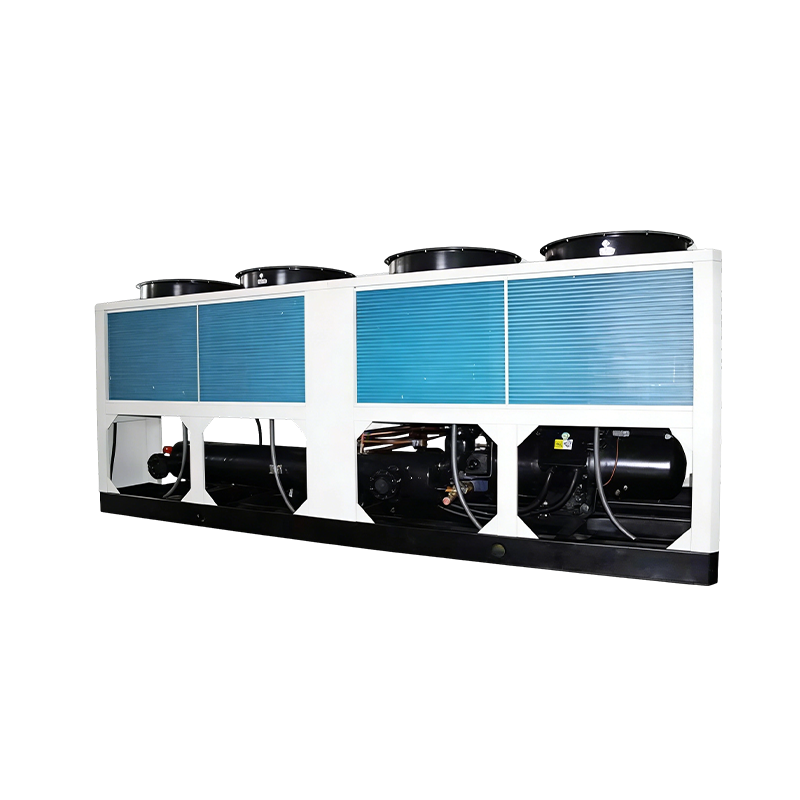
For continuous process duty above roughly 100 kW, a screw-based package such as Soouney's heat-cryogenic air-cooled screw chiller provides longer service intervals and better part-load control than a scroll-based unit at the same capacity.
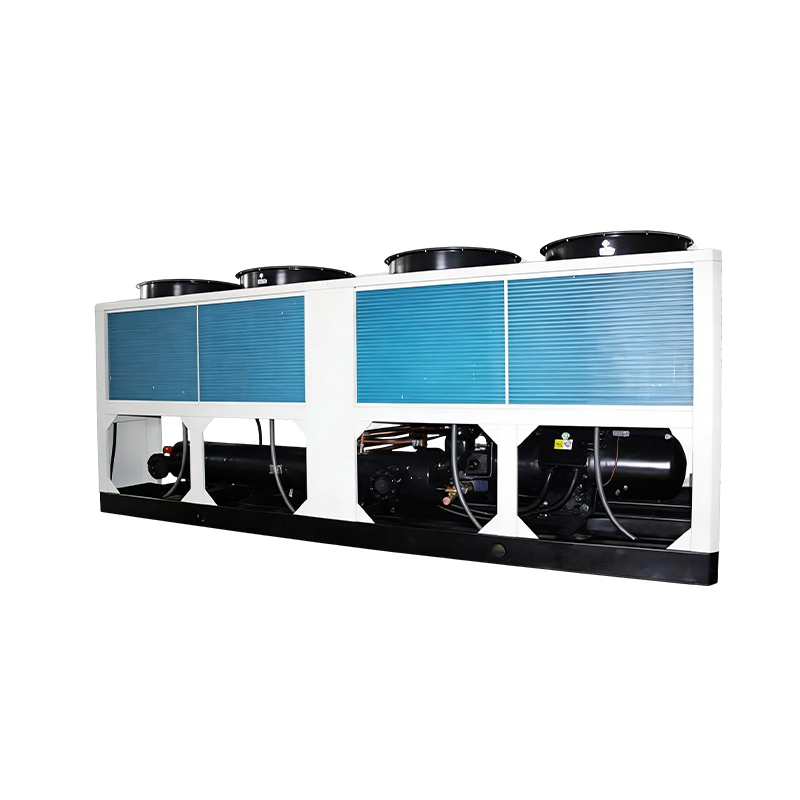 Wholesale Heat Cryogenic Single Compressor Double Compressors Air Cooled Screw CShanghai Soouney Refrigeration Equipment Co., Ltd. Is China Wholesale Heat Cryogenic Single Compressor Double Compressors Air Cooled Scre...View Product →
Frequently Asked Questions
What temperature range can an air-cooled industrial chiller deliver?
Standard models are selected for 5-15°C leaving water. Setpoints below 5°C require a glycol mixture and a low-temperature machine; the cryogenic series extends the same air-cooled design to subzero process cooling for chemical and pharmaceutical duty.
Can an air-cooled chiller replace an existing water-cooled chiller?
Yes, in most medium-load plants. The main changes are removing the cooling tower and water-treatment loop, mounting the air-cooled unit outdoors, and accepting 15-30% higher input power per kW of cooling because condensing pressure follows the ambient temperature curve.
How much capacity does an air-cooled chiller lose in hot weather?
Capacity is published at a rating ambient, normally 35°C. At 40°C ambient, a standard model can deliver 8-12% less cooling. Sizing must therefore be based on the worst summer month, not the annual average.
What information does a manufacturer need before quoting a chiller?
Prepare five inputs: total process heat load in kW, required leaving water temperature, design ambient temperature, available electrical supply, and the distance from the unit to the process. These are enough to propose a capacity, a model family, and a pump set.
Soouney manufactures air-cooled box chillers, air-cooled screw chillers, and complementary cooling components for exactly these process duties. A quote with the correct capacity and model starts from the five inputs listed above.