
 English
 Español

Content
- 1 Where High-Capacity Process Cooling Begins
- 2 How a Twin-Screw Compressor Moves That Much Heat
- 3 Capacity Control Decides the Annual Power Bill
- 4 Water-Cooled, Air-Cooled or Evaporative Condensing
- 5 Sizing, Redundancy and Heat Rejection
- 6 Service Intervals and Lifecycle Cost
- 7 Questions Specification Teams Ask
Process cooling above 300 kW rarely fails because a plant bought too little tonnage. It fails because the compressor cannot follow the load curve. A plating shop may draw 55 percent of installed capacity for eleven months and then 100 percent for three weeks in July. Screw chillers were built for exactly that profile: one packaged machine covering 175 kW to 3,500 kW with continuously variable output between roughly a quarter and full load.
That capacity band sits between two technologies that both struggle away from the design point. Centrifugal compressors rely on aerodynamic lift and begin to surge below roughly 40 percent of design flow, which forces hot-gas bypass or a second machine to cycle on and off. Banks of scroll compressors handle part load well but multiply the piping, wiring, oil management and sequencing logic across the plant. A screw compressor is a positive-displacement machine, so it traps and squeezes a fixed volume of refrigerant instead of accelerating it, and it holds stable operation at 25 percent load with no anti-surge hardware at all.
Where High-Capacity Process Cooling Begins
Screw chillers become the economical choice at roughly 175 kW (50 TR) of connected process load and remain the standard option up to about 3,500 kW (1,000 TR) per packaged unit.
Below 175 kW, scroll and reciprocating machines cost less to buy and are easier to service, and their efficiency penalty stays small because the load itself is small. Above 3,500 kW, centrifugal machines regain an advantage at full load, but they need surge protection and often a second compressor frame to cover the part-load hours that dominate the calendar year. The screw band is wide precisely because it tolerates both ends of that range without extra machinery, and because the same frame can be built as a water-cooled, air-cooled or evaporative condensing package.
| Cooling capacity | Common compressor type | Typical process duty |
| 35 to 175 kW | Scroll, reciprocating | Injection molding cells, laser cutting, laboratory baths |
| 175 to 700 kW | Single-screw, twin-screw | Extrusion lines, coating and laminating, hydraulic power units |
| 700 to 1,750 kW | Twin-screw, dual-compressor | Chemical reactors, die casting, film and foil lines |
| 1,750 to 3,500 kW | Multi-compressor screw, centrifugal | Data halls, district cooling, large plating and anodizing lines |
Temperature matters as much as tonnage. Most process cooling runs with a chilled-water supply between 5 and 15 C, but screw machines using glycol blends and low-temperature oil management reach -30 C evaporating temperature for freeze-drying, cold-chain test rooms and pharmaceutical crystallization. That low-temperature capability comes from the compression mechanism itself rather than from an added booster stage.
How a Twin-Screw Compressor Moves That Much Heat
A screw chiller compresses refrigerant with a pair of intermeshing helical rotors turning at roughly 2,950 rpm on a 50 Hz supply, which is why one frame size can span 175 kW to 1,000 TR without changing the compression principle.
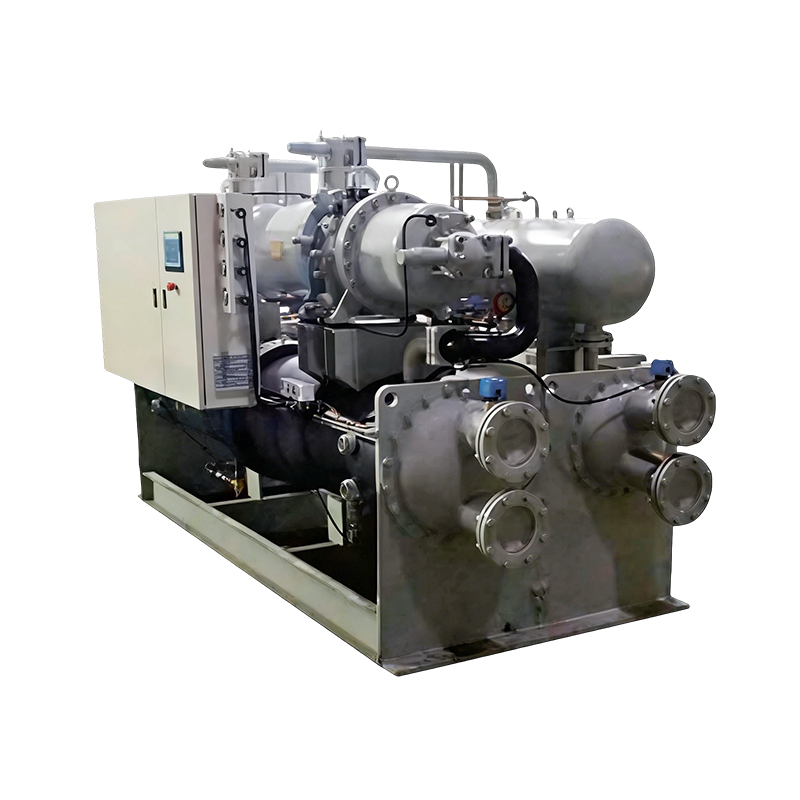
A screw chiller is a positive-displacement vapor-compression machine in which a male and a female helical rotor mesh to trap refrigerant gas in a moving cavity and compress it continuously, with oil injected for sealing, lubrication and rotor cooling instead of using suction and discharge valves.
The male rotor typically carries five lobes against six flutes on the female rotor, a 5:6 profile that fixes the built-in volume ratio of the machine. Because gas is trapped and displaced rather than accelerated, the compressor has no suction valve to bend, no discharge valve to flutter and no clearance volume to re-expand on every revolution. The compression cycle runs continuously instead of in pulses, which keeps discharge pressure steady and makes the machine noticeably quieter than a reciprocating equivalent of the same capacity.
Oil injection also gives the screw compressor a wide evaporating range. The injected oil absorbs heat of compression and seals the rotor clearances, so a single stage can hold a pressure ratio that would require two impellers on a centrifugal machine. In practice this means one chiller can deliver 7 C water for a normal production day and be reconfigured with a glycol charge for -20 C operation on the same frame, which is the configuration behind low-temperature packages built for freeze-drying and cold-chain testing rooms.
Capacity Control Decides the Annual Power Bill
Screw chillers modulate load with a slide valve that travels along the rotor housing, delivering continuously variable capacity from 25 percent to 100 percent, and a variable frequency drive extends that turndown to roughly 10 percent.
The reason turndown matters more than the full-load nameplate is how part-load efficiency is scored. AHRI Standard 550/590 assigns 1 percent of the integrated part-load value weighting to 100 percent capacity, 42 percent to 75 percent capacity, 45 percent to 50 percent capacity and 12 percent to 25 percent capacity. Almost half of the score, and roughly half of real annual energy use, is decided at a point where the slide valve is barely halfway open.
Flooded evaporator designs widen that advantage further. A flooded barrel keeps the tube bundle submerged in liquid refrigerant, so the evaporating temperature stays closer to the leaving chilled-water temperature and the compressor sees a higher suction pressure at part load. For a plant running three shifts, the difference between a flooded and a direct-expansion barrel at 50 percent load is usually worth more than the difference in purchase price.
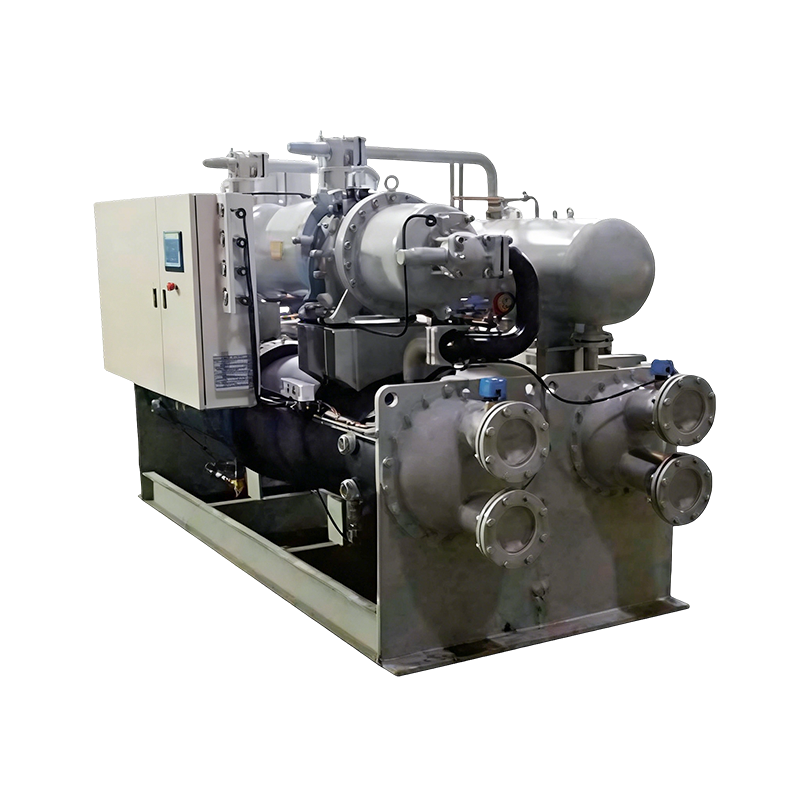 Water Cooled Screw Flooded ChillerElectronic expansion valve Electronic expansion valve has proportional integral regulator technology, to allow better control of air conditioner units and reduce runni...View Product →
Water-Cooled, Air-Cooled or Evaporative Condensing
At AHRI 550/590 rating conditions, a water-cooled screw chiller typically reaches a full-load COP of 6.0 to 6.5, an evaporative condensing machine reaches 4.8 to 5.4, and an air-cooled screw chiller reaches 2.9 to 3.2.
The gap comes from condensing temperature. A water-cooled condenser sees entering water at 29.4 C, which corresponds to a condensing temperature near 35 C. A dry air-cooled condenser must reject heat to ambient air at 35 C, which pushes condensing temperature past 48 C and forces the compressor to work against a much higher pressure ratio for the same cooling effect.
| Condensing method | Typical full-load COP | Water demand | Best fit |
| Water-cooled | 6.0 to 6.5 | Tower makeup, roughly 1.5 to 2 percent of circulating flow per 10 K of range | Plants with an existing cooling water loop or tower deck |
| Evaporative condensing | 4.8 to 5.4 | Lower than a separate tower loop, same water treatment discipline | Retrofits where tower space is limited but water is available |
| Air-cooled | 2.9 to 3.2 | None | Water-scarce sites, temporary plants, modular production halls |
Water-cooled packages are the default for continuous duty above 500 kW, because the smaller condenser surface and higher suction pressure reduce compressor power for the same delivered tonnage.
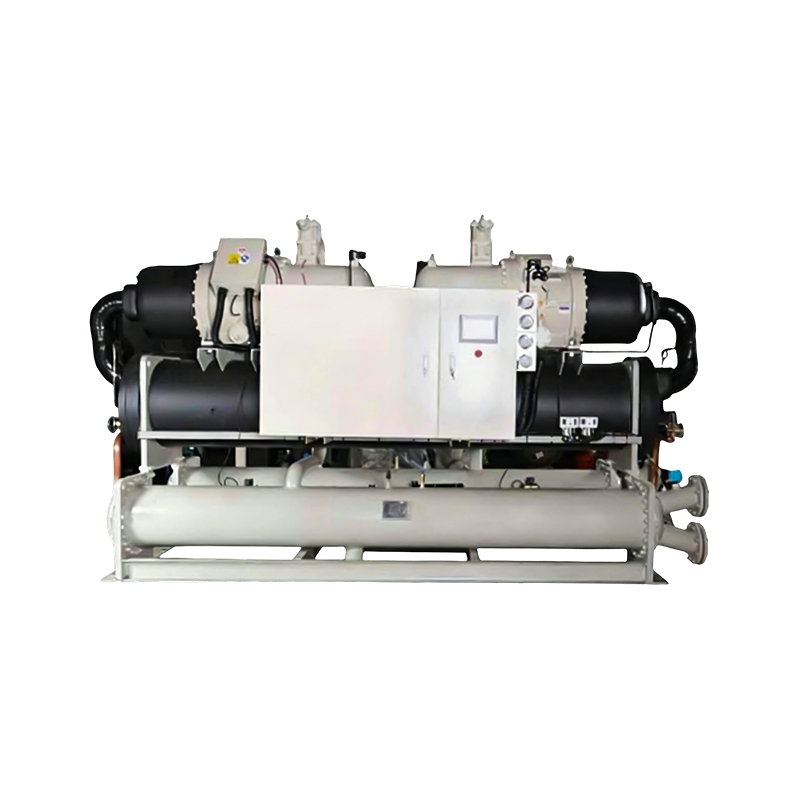 Water Cooled Screw Chiller ManufacturersWater Cooled Screw ChillerView Product →
They do require a tower and a water treatment program, and the condenser tubes need periodic brushing or chemical cleaning. In plants where that trade is acceptable, the energy saving usually repays the added balance-of-plant cost within three to five years of continuous operation.
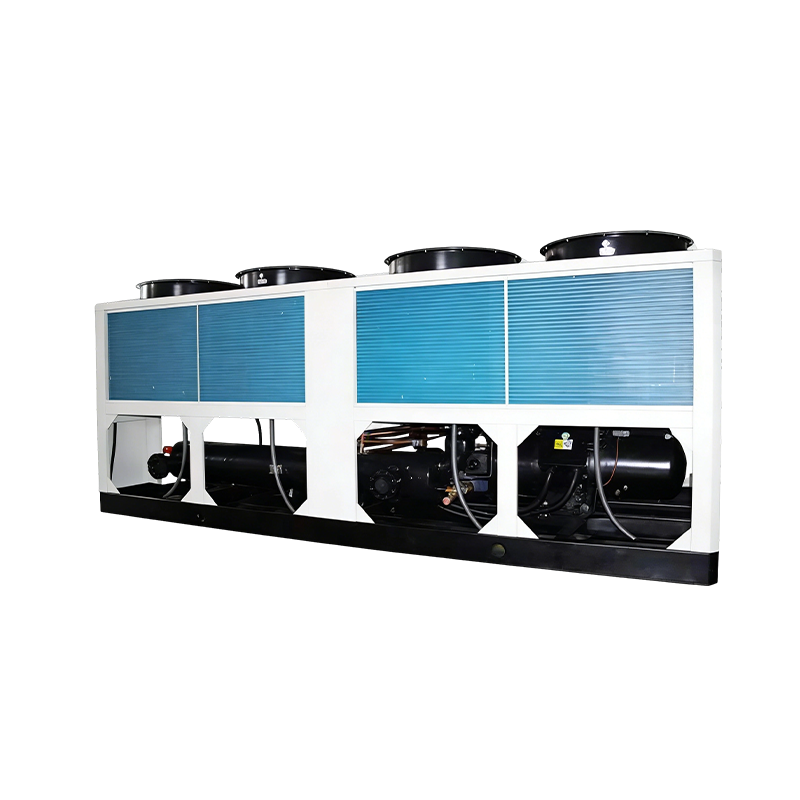 Air Cooled Screw Chiller ManufacturersAir Cooled Screw ChillerView Product →
Air-cooled machines remove the water dependency entirely and are the correct choice where a tower permit is unavailable or where winter freeze protection would be a recurring problem. Expect a larger footprint per ton of cooling and a condenser coil that needs cleaning on a schedule tied to local dust conditions rather than to water chemistry.
Sizing, Redundancy and Heat Rejection
Size a screw chiller on the highest simultaneous process load plus a 10 to 15 percent margin, never on the sum of every connected machine nameplate in the building.
Nameplate diversity is the most common source of oversized equipment. Thirty molding machines at 20 kW each do not produce 600 kW of simultaneous load; measured data from the plant's own cooling loop usually shows 55 to 75 percent of that figure. Oversizing costs twice, because the extra tonnage raises the purchase price and then forces the machine to run at low load where the slide valve has the least authority.
- Build a load profile from measured flow and temperature differential across a full production week, not from a single summer afternoon.
- Add 10 to 15 percent to the peak of that profile to cover fouling, future tooling and control deadband.
- Check the condensing side at the local design wet-bulb or dry-bulb temperature, not at an annual average.
- Plan N+1 redundancy at the system level, using two smaller frames rather than one large frame where downtime is expensive.
- Confirm the electrical supply can carry locked-rotor current for the largest compressor plus the running load of everything else on the panel.
System integration matters as much as the chiller itself. Hydraulic separators, buffer tanks of 5 to 10 liters per kW, and strainers on the evaporator inlet prevent the short cycling and tube fouling that erode part-load performance. Where the plant already has a mixed cooling water system, a qualified comparison of industrial chiller options for different cooling duties helps confirm whether a screw frame or a smaller alternative fits the actual load profile.
Service Intervals and Lifecycle Cost
A screw compressor designed to L10 bearing life above 100,000 running hours needs an oil and filter change every 8,000 to 12,000 hours, and annual maintenance typically runs at 2 to 3 percent of the equipment purchase price.
The compressor itself is rarely the maintenance driver. Oil condition is, because the same oil that seals the rotor clearances also lubricates the bearings, and it degrades faster when the machine runs at high condensing temperature. Sampling oil every 2,000 hours and trending viscosity and acidity catches most problems before they reach the rotor.
Cooling water treatment and blowdown control, condenser tube brushing or chemical cleaning once or twice a year, tower fan and pump inspection each quarter.
Coil cleaning tied to dust conditions, fan bearing lubrication, no water treatment program, and no freeze protection during winter shutdown.
Compressor overhaul intervals stretch to 40,000 to 60,000 hours on well-maintained machines, and the overhaul is usually a bearing and seal replacement rather than a rotor replacement. The practical lifecycle rule is simple: keep condensing temperature low, keep oil clean, and keep the evaporator strainer in place, and the machine will hold its rated capacity for fifteen to twenty years of continuous industrial duty.
Questions Specification Teams Ask
How much capacity headroom does a screw chiller need?
Add 10 to 15 percent to the measured peak simultaneous load. That margin covers condenser fouling, tooling changes and control deadband without pushing the machine into a low-load region where capacity control becomes less precise.
At what load does a screw chiller become cheaper to run than multiple scroll units?
From about 175 kW upward, because one slide-valve screw frame replaces three to five scroll circuits, removes the need for staged sequencing, and concentrates oil management in a single sump with one oil change interval instead of five.
Can a screw chiller serve both normal and low-temperature process cooling?
Yes. With glycol in the loop and low-temperature oil management, a single-stage screw machine reaches -30 C evaporating temperature, which covers freeze-drying, cold-chain test rooms and crystallization duty without adding a booster compressor.
What chilled-water temperature stability should be specified?
Specify plus or minus 0.5 K at steady load for most process work, and plus or minus 0.3 K for coating, laser or semiconductor-adjacent processes. Stability depends on buffer volume and control resolution as much as on the compressor itself.